 |
 |
 |
 |
 |
 |
 |
 |
 |

 |
New Thermal Protection Technologies For Reusable Launch Vehicles To Be Validated
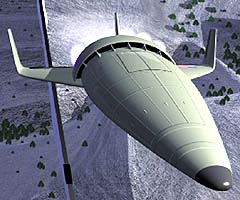
El Segundo CA (SPX) Dec 04, 2007 Northrop Grumman and the U.S. Air Force Research Laboratory (AFRL), Dayton, Ohio, will help move the Air Force closer to its goal of developing reusable launch systems under a new concept research and development contract. The four-year, $2.9 million effort is known as the Advanced Development of Integrated Warm Structures (ADIWS). It will demonstrate the relative weight and performance benefits of using different types of thermal protection systems (TPS) and composite materials to produce reusable, two-stage-to-orbit launch systems. The contract will build on work that Northrop Grumman has done previously with NASA to mature TPS technologies for composite reusable launch vehicles. The ADIWS contract is being issued as a task order under an indefinite delivery, indefinite quantity contract managed by Universal Technology Corporation, Dayton, Ohio. "Vehicles going through re-entry generally experience thermal conditions that exceed the limits of a normal metal airframe and skin," explains Dennis Poulos, director of military space programs for Northrop Grumman's Integrated Systems sector. "These conditions force us to depend on heavy and expensive TPS materials much like the Space Shuttle would use. By using higher temperature composite structures and panels, we'll be able to use fewer TPS materials on our airframe, resulting in a lighter weight, higher performing vehicle that's less expensive to operate and maintain." Under the ADIWS contract, Northrop Grumman and the Air Force will design and produce hardware that will test the performance and durability of both metallic and non-metallic TPS materials on traditional graphite-epoxy composites, and a newer, more heat-resistant composite material called polyimide. Polyimide-based composites can withstand re-entry temperatures of up to 600 F, whereas traditional graphite epoxy composites will melt above 250 F if not covered with TPS materials. According to Tod Palm, Northrop Grumman's lead engineer on the contract, the baseline hardware for the contract will be a traditional graphite epoxy panel to which metal TPS materials have been attached. The panel will be subjected to rigorous thermal, vibration and acoustic testing in a test facility at AFRL. The panel will also be tested with non-metallic TPS attached. In a second phase of the contract, the team will design and test a polyimide composite panel containing both metallic TPS and carbon-silicon carbide (C-SiC) composite TPS. This integrated polyimide panel will also be tested at the AFRL facility. "These tests will validate the performance of our elevated temperature airframe and non-metallic TPS materials," said Palm. "The Air Force has estimated that using non-metallic TPS materials on a polyimide airframe could reduce the weight of the TPS by approximately 46 percent compared to using metallic TPS on a graphite epoxy airframe. We intend to demonstrate that these newer, lighter weight technologies offer a mature, high-confidence approach to producing reusable launch systems." Related Links Rocket Science News at Space-Travel.Com
 Russian Engineering truths -- Part 1
  Washington (UPI) Nov 27, 2007
 Are there lessons for U.S. defense contractors in the record of the Russian civilian space program? After all, over the past quarter century, and even during the chaotic decade that followed the collapse of communism, that program, now run by the Russian Federal Space Agency, Roskosmos, has compiled a record of longevity, cost-effectiveness and reliability without equal in the history of manned space flight. It was begun in the face of the Soviet communist bureaucracy, which after 1965 was largely apathetic and provided a minimum of resources in the face of fierce global economic competition. |
|
|

| The content herein, unless otherwise known to be public domain, are Copyright Space.TV Corporation. AFP and UPI Wire Stories are copyright Agence France-Presse and United Press International. ESA Portal Reports are copyright European Space Agency. All NASA sourced material is public domain. Additional copyrights may apply in whole or part to other bona fide parties. Advertising does not imply endorsement, agreement or approval of any opinions, statements or information provided by Space.TV Corp on any Web page published or hosted by Space.TV Corp. Privacy Statement |