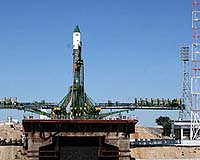
Are there lessons for U.S. defense contractors in the record of the Russian civilian space program? After all, over the past quarter century, and even during the chaotic decade that followed the collapse of communism, that program, now run by the Russian Federal Space Agency, Roskosmos, has compiled a record of longevity, cost-effectiveness and reliability without equal in the history of manned space flight. It was begun in the face of the Soviet communist bureaucracy, which after 1965 was largely apathetic and provided a minimum of resources in the face of fierce global economic competition.
How do they do it? Alexei Ivanovich Vasiliev is one of the reasons. When United Press International interviewed him 3-1/2 years ago at the Baikonur Cosmodrome in Kazakhstan, he was deputy director of construction at the General Production Bureau at Baikonur, operating the Gagarinskaya manned launch complex under Russia's Federal Space Agency. At that time, he remained the senior flight engineer running Gagarinskaya, and he has been working there for 37 of its 43 years.
At Cape Canaveral — or probably anywhere else at the National Aeronautics and Space Administration or its big corporate contractors' facilities — it is probable the lean, suntanned, friendly and outgoing Vasiliev could not even get a job. For one thing, he was too old at age 68. For another, he does not have a doctoral degree from Caltech, MIT or anywhere else for that matter. He is not even a whiz on high-tech software systems. There still are not that many of them on the engineering side at Baikonur.
Nevertheless, Vasiliev has been worth his weight in gold to Russia's surprisingly robust and profitable space program, and the vast experience and technical knowledge he brought to its everyday operations was beyond calculation.
The Gagarinskaya Complex, of course, is named after cosmonaut Yuri Gagarin, the first human to be launched into space with his 108-minute orbital flight on April 12, 1961 — from that site.
The complex reflects the great, robust and practical traditions of Russian heavy engineering. Although the Central Asian steppes of Kazakhstan can experience temperature variations of 150 degrees from the baking 140-degree heat of summer to the deep snow blizzards and howling winds down to minus 10 degrees of mid-winter, the Baikonur launching systems are designed to resist all that.
The launching mechanisms on the pad all are retractable deep into the ground, and the rockets are transported by horizontal rail links to their launching points at the last possible moment. Indeed, the new generation of satellite launch boosters — like the highly reliable Dnepr rocket, adapted from the old Soviet SS-18 intercontinental ballistic missile — is launched entirely from underground silos.
The Gagarinskaya Complex, Vasiliev pointed out, was quickly superseded by later designs. Like all good engineers, the ones at Baikonur never stop learning from their own equipment and are always incrementally modifying it.
The launch pad, Vasiliev pointed out, remained highly labor intensive. In 2004 it still took up to 350 engineers and industrial workers to operate it. Later designs required far smaller work teams. Despite its mass — the entire launch pad mechanism weighs 600 tons — it can rotate 360 degrees.
Also, the pad goes down deep. Very deep.
"This the deepest launch complex in the world," Vasiliev said. "It goes down more than 43 meters (around 130 feet). That is because it was the first launching pad of its kind in the world to be designed for the launching of heavy rockets. But when we had more experience, we realized we didn't need to put our launching mechanisms so deep."
(Next: The need for experience)