 |
 |
 |
 |
 |
 |
 |
 |
 |

 |
State Council Meets To Discuss Space Matters
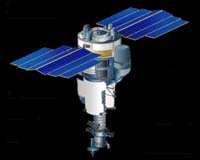
Moscow (RIA Novosti) Apr 02, 2007 The fact that the State Council, an advisory body to the Russian president, met on March 29 to discuss Russian aerospace and that the meeting was attended by President Vladimir Putin points to the importance which the country's leadership attaches to the space industry. Notably, the council met in Kaluga, the hometown of Konstantin Tsiolkovsky, the father of aerospace theory. The topics discussed included not only the situation surrounding Russian satellites now in orbit, but also the manufacture of space hardware, future research, and financing. According to Russian Space Agency chief Anatoly Perminov, the country's group of satellites looked much better in 2006 than it had in many years, although it is still far from having made a complete recovery. In his words, "it was possible not only to stop the rapid decline in the quality of the orbital grouping, but also to begin its rehabilitation." Today, Russian rockets account for about 40% of all space launches in the world every year. In 2006, for the first time in many years, Russia launched a state-of-the-art remote-sensing probe called Resurs-DK. It is already in orbit, taking an inventory of natural resources for the forest and fishery industries and taking pictures from space. The crisis in remote sensing of the Earth is therefore over. The re-emergence of a Russian satellite navigation system is also proceeding apace. As First Deputy Prime Minister Sergei Ivanov said, 18 satellites for GLONASS (Global Navigation Satellite System), the Russian version of GPS, will be put into orbit before the end of this year, and by 2009 the system will be able to operate on a regular basis with 24 craft to ensure global navigation. Newly launched satellites are more advanced than the older ones, and have a longer service life. However, putting navigational services within the reach of end users is still a problem, and progress has been very slow here. Work is also continuing on the International Space Station (ISS). For several years, Russia has been the only country carrying cargoes, fuel and relief crews to the station. Research modules are being prepared for launch to dock with the ISS. However, attitudes are mixed regarding the continued operation of the station. The Americans have cooled to the project. In Russia, ISS supporters think the station is necessary to test techniques for long-range interplanetary missions. Tellingly, however, the chief of the Energia rocket corporation was absent from the meeting: either because he was not invited or because he thought it better to attend the launch of a new manned expedition aboard a Soyuz from the Baikonur Space Center in Kazakhstan. Lev Zeleny, director of the Space Research Institute and member of the Russian Academy of Sciences, is unhappy about the Russian space research program. Today Russia has no scientific spacecraft in orbit, and the last one was launched more than ten years ago. Planetary projects are very slow in getting off the ground. The soonest of them - Fobos-Grunt - is slated for 2009 at the earliest. Unmanned missions to the Moon and Venus are even further off. For the moment, Russian scientists have joined foreign planetary missions as co-researchers and have obtained fairly good results, often better than the host's. Work has resumed on three astrophysical projects that were to have been implemented in the 1990s but have been taken off the shelf only now, almost two decades later. Speaking at the meeting, President Putin said that the main objective must be to make better use of the findings of space research in navigation, communications, geology, television, radio broadcasting, medicine, ecology, agriculture, education and many other areas. A special program must be drawn up to cover the period from 2009 to 2015. The year 2007 should in effect be the Year of Aerospace because it is witnessing three milestones: the 150th birth anniversary of Konstantin Tsiolkovsky, the outstanding rocket scientist and pioneer of cosmonautics, the 100th birth anniversary of Sergei Korolyov, the renowned Russian rocket designer, and half a century since the launch of the first satellite. Yury Zaitsev is an analyst with the Space Research Institute of the Russian Academy of Sciences The opinions expressed in this article are the author's and do not necessarily represent those of RIA Novosti.
Source: RIA Novosti Related Links The latest information about the Commercial Satellite Industry Station and More at Roscosmos S.P. Korolev RSC Energia Russian Space News
 Ambitious Goal Of Sergei Korolev
 Moscow, Russia (RIA Novosti) Jan 16, 2007
January 12 marks a hundred years since Sergei Korolev's birth and 41 years since his death. It was only after he died that the nation and the rest of the world learnt the name of the Chief Designer of Soviet missile and space systems, and the founder of cosmonautics. Usually, Korolev's name is associated with the first achievements of Soviet cosmonautics - the first satellite, the first lunar robot, the first interplanetary station, and the first manned flight into space. |
|
|

| The content herein, unless otherwise known to be public domain, are Copyright Space.TV Corporation. AFP and UPI Wire Stories are copyright Agence France-Presse and United Press International. ESA Portal Reports are copyright European Space Agency. All NASA sourced material is public domain. Additional copyrights may apply in whole or part to other bona fide parties. Advertising does not imply endorsement, agreement or approval of any opinions, statements or information provided by Space.TV Corp on any Web page published or hosted by Space.TV Corp. Privacy Statement |