 |
 |
 |
 |
 |
 |
 |
 |
 |

 |
Students Working On Space Suit Redesign For NASA
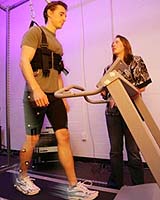
Houston, TX (SPX) Feb 13, 2007 Space suits for astronauts may get a new and better design following a University of Houston doctoral student's locomotion stability research. Melissa Scott-Pandorf is a Fellow of the Texas Space Grant Consortium. "NASA's mission to send humans back to the Moon is closer to a reality every day," Scott-Pandorf, a doctoral student in the UH Department of Health and Human Performance, said. "Astronauts will need to travel easily over the planet's terrain, meaning their mobility will be important for overall mission success." To begin her study, Scott-Pandorf looked at hours and hours of lunar moon-walk video to determine how fast and how far astronauts traveled wearing all of the needed equipment. That information, combined with metabolic indicators collected while the astronauts worked on the lunar surface, was used to calculate the amount of energy expelled while walking on the moon. Scott-Pandorf said this is valuable information that will help NASA officials decide how much is too much to include on an astronaut's space suit. "I can't tell you how many times I watched the astronauts fall down on the lunar videos," she joked. "Obviously, it isn't meant to be funny. But it's difficult for them to get up with the survival pack on their back and those bulky suits. We're hoping our new research projects will lead to a streamlined space suit that makes it easy to navigate the terrain." As part of her new work, Scott-Pandorf uses a weight suspension system in the UH Laboratory of Integrated Physiology (LIP). The apparatus is used as a reduced gravity simulator that helps to evaluate locomotion stability. A subject is buckled into the suspension system and simply walks as Scott-Pandorf records data about the person's gait. With this system, she can investigate how mass distribution and pressure levels of the space suit may influence the ease in which astronauts travel a planet's terrain. "For one thing, it's clear that the placement of the life support pack is too high on the astronaut," Scott-Pandorf said. "Possible redesign ideas are to alter the pack to fit the front and back of the space suit evenly or create a pack that attaches closer to the waist, which would lower the astronaut's center of gravity. It's the same idea as if you were balancing on a surf board bending your knees and staying low. This lowers your center of mass and allows you more stability." Scott-Pandorf is also considering research to investigate the mobility needed at the joints of the space suit that would allow an astronaut to move more naturally, making it easier to recover from a fall or to keep from falling at all. "In addition, the space suspension system we are using is similar to what has been used as therapy tools for persons with spinal cord injuries or the elderly. Conceivably using the system for our research could usher in new ideas for new therapies for those populations," Scott-Pandorf said. The Texas Space Grant Consortium was founded in 1989 and is comprised of 34 universities, industrial organizations, non-profit organizations and government agencies within the state. The consortium supports educational and research projects that further NASA's mission: to protect and understand our planet, improve life on Earth, extend life beyond our planet and explore the universe. Scott-Pandorf will work with NASA and UH for the extent of her fellowship. Scott-Pandorf's research on locomotion has included assisting UH Professor Max Kurz in his study of stability and locomotion. In that study, he recorded the waddling of penguins to determine how the manner of movement assisted in crossing rugged terrain. Related Links Scott-Pandorf's research on locomotion Space Tourism, Space Transport and Space Exploration News
 US Astronaut Charged With Attempted Murder Of Love Rival
 Miami (AFP) Feb 06, 2007
A NASA astronaut who flew on the shuttle Discovery last July was charged with attempted murder Tuesday after driving cross-country to attack a woman she believed a rival for the affections of a fellow astronaut, police said. Lisa Nowak, 43, a US Navy captain and a married mother of three, faces a maximum life prison sentence if convicted of the attempted first degree murder and kidnapping charges lodged against her in Orlando, Florida. |
|
|

| The content herein, unless otherwise known to be public domain, are Copyright Space.TV Corporation. AFP and UPI Wire Stories are copyright Agence France-Presse and United Press International. ESA Portal Reports are copyright European Space Agency. All NASA sourced material is public domain. Additional copyrights may apply in whole or part to other bona fide parties. Advertising does not imply endorsement, agreement or approval of any opinions, statements or information provided by Space.TV Corp on any Web page published or hosted by Space.TV Corp. Privacy Statement |