Less shake, more action.
Less shake, more action. |
Their efforts have led to the Elastic Memory Composite Hinge, which is comprised of a mixture of carbon fiber strands and an epoxy resin. EMCH operates by temperature application, becoming pliable when heated and then maintaining a stiff position while cooling.
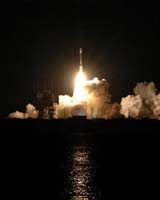
EMCH has demonstrated a gradual, controlled functionality that protects, not harms, the item it will deploy. For example, during launch when intense shaking can occur within the rocket body, the hardened compound material restricts the movement of deployable objects, but once the spacecraft reaches orbit, the opposite transpires as increased temperatures from the sun or an internal energy source placed on the apparatus creates elasticity.
EMCH, is undergoing evaluation on the International Space Station. It was on board Space Shuttle Discovery when the shuttle docked with the International Space Station in December 2006. A crew member transferred the EMCH demonstration, which involved a clear self-contained, Plexiglas box, measuring 10 inches by 20 inches by 17 inches, featuring three sets of tests with two hinges apiece. It's scheduled to remain on the International Space Station for 18 months.
According to 1st Lt. Corey Duncan, EMCH program manager, EMCH serves as a low-mass, low-complexity replacement for current deployment mechanisms.
"Additionally, these hinges will mitigate spacecraft shock that is typically experienced in deployment devices," Lieutenant Duncan said.
"If the EMCH's performance is validated during its stint on the International Space Station, it will reduce the risk of shake, rattle, and roll to future space programs, as well as to the next generation of vehicles operating in the cosmos.
"CTD's innovation is a highly cost-effective way of validating elastic memory composite technology and accelerating the transition of this technology to the warfighter. In the end, the EMCH provides the Defense Department and civilian space programs with a more reliable and less complex deployment capability for their spacecraft."
The Space Vehicles Directorate, one of nine technology directorates under the Air Force Research Laboratory, sponsored the EMCH project. Composite Technology Development, Inc., designed, advanced, and tested the EMCH system.
Related Links
 DemoFlight 2 Launch Update
 Los Angeles CA (SPX) Feb 09, 2007
| The content herein, unless otherwise known to be public domain, are Copyright Space.TV Corporation. AFP and UPI Wire Stories are copyright Agence France-Presse and United Press International. ESA Portal Reports are copyright European Space Agency. All NASA sourced material is public domain. Additional copyrights may apply in whole or part to other bona fide parties. Advertising does not imply endorsement, agreement or approval of any opinions, statements or information provided by Space.TV Corp on any Web page published or hosted by Space.TV Corp. Privacy Statement |