
SPACE TRAVEL SPACE DAILY SPACE WAR TERRA DAILY MARS DAILY SPACE MART GPS DAILY ENERGY DAILY
  Space Travel News  
Get Our Free Newsletters Via Email
  
Search All Our Sites at SpaceBank
Speeding To Zeus On Route Pluto

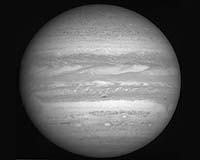
This image of Jupiter is produced from a 2x2 mosaic of photos taken by the New Horizons Long Range Reconnaissance Imager (LORRI), and assembled by the LORRI team at the Johns Hopkins University Applied Physics Laboratory. The telescopic camera snapped the images during a 3-minute, 35-second span on February 10, when the spacecraft was 29 million kilometers (18 million miles) from Jupiter. At this distance, Jupiter's diameter was 1,015 LORRI pixels - nearly filling the imager's entire (1,024-by-1,024 pixel) field of view. Features as small as 290 kilometers (180 miles) are visible.

Both the Great Red Spot and Little Red Spot are visible in the image, on the left and lower right, respectively. The apparent "storm" on the planet's right limb is a section of the south tropical zone that has been detached from the region to its west (or left) by a "disturbance" that scientists and amateur astronomers are watching closely. At the time LORRI took these images, New Horizons was 820 million kilometers (510 million miles) from home - nearly 5½ times the distance between the Sun and Earth. This is the last full-disk image of Jupiter LORRI will produce, since Jupiter is appearing larger as New Horizons draws closer, and the imager will start to focus on specific areas of the planet for higher-resolution studies. Credit: NASA/Johns Hopkins University Applied Physics Laboratory/Southwest Research Institute

by Alan Stern
Laurel MD (SPX) Feb 22, 2007
We're a week from Jupiter closest approach. And if you're monitoring the "Where Is New Horizons?" page, you've likely noticed that we're already accelerating because of Jupiter's gravity. Although the effect is relatively small now, it will build dramatically in the coming days, giving us a boost of approximately 9,000 miles per hour (nearly 14,500 kilometers per hours) by the middle of next week. That's half the speed of a space shuttle in Earth orbit - essentially for free!

Meanwhile, the New Horizons spacecraft and payload are still performing well. As is the case most weeks, no unexpected events occurred; further, all of the Jupiter observations have been conducted just as planned. Additionally, continued tracking data shows us right on course to the "Pluto keyhole" - the spot near Jupiter we have to hit to remain on target to Pluto.

This is the last week of the low-intensity observation period before the Jovian onslaught that begins this Saturday, February 24. The highlight of this coming week for me is a pair of observations by our Alice ultraviolet spectrometer, which will observe a stellar occultation of Jupiter on Thursday, probing its upper atmospheric temperature and density profile.

Next week the pace of operations reaches its crescendo near Jupiter, with some 15-20 observation sequences each day. We'll observe Jupiter, its rings, its moons and its magnetosphere.

Also next week, the New Horizons Science Team will meet to plan the data analysis activities to come, and to begin planning (already!) for our Pluto encounter. Sure the Pluto system is eight years away, but when I watched a movie last weekend on TV from 1999, I realized that eight years seemed like yesterday. So onward we go - it's a long but worthy haul to the frontier that is the Kuiper Belt.

I'll be back with more news and views next week. Keep exploring!

Email This Article

Related Links
Pluto and New Horizons at APL
All about the technology of space and more
News About Space Exploration Programs

NASA And Virgin Galactic To Explore Future Cooperation
Moffett Field CA (SPX) Feb 22, 2007
NASA officials announced they have signed an agreement with a U.S. company, Virgin Galactic, to explore collaborations on development of future space systems and support to commercial human spaceflight activities. Under the terms of a Memorandum of Understanding (MOU), NASA Ames Research Center and Virgin Galactic will explore possible collaborations in several technical areas.


Memory Foam Mattress Review

Newsletters :: SpaceDaily Express :: SpaceWar Express :: TerraDaily Express :: Energy Daily
XML Feeds :: Space News :: Earth News :: War News :: Solar Energy News
  • NASA Solicits Ideas For Constellation Ground Work
  • New Space Technology Provides Less Shake Rattle And Roll
  • DemoFlight 2 Launch Update
  • SpaceDev Conducts Hot-Fire Test Of Hybrid Upper Stage Rocket Motor

  • Russia Space Agency Hopes Sea Launch Will Resume Operation In 2007
  • SERVIS-2 To Be Launched On Rockot
  • United Launch Alliance First East Coast Launch A Total Success
  • ILS Proton To Launch Ciel-2 Satellite To Serve North America

  • Atlantis Countdown Testing Begins
  • Atlantis Rolls Out to Pad
  • Space Shuttle Closer To Launch
  • NASA's Shuttle Atlantis Rolls to Vehicle Assembly Building

  • Soyuz TMA-10 Spacecraft To Launch Expedition 15 Crew To ISS On April 7
  • ISS Crew Continue Preparations For Spacewalk
  • Expedition 14 Continues Preperations For February 22 Spacewalk
  • Astronauts Prepare For Next Weeks Spacewalk

  • NASA And Virgin Galactic To Explore Future Cooperation
  • Detecting Radiation On Lunar And Mars Missions
  • Space Radiation Could Be A Mars Mission-Killer
  • Speeding To Zeus On Route Pluto

  • If You Love Me Order Some Purple Space Potatoes
  • China, US Have No Space Cooperation
  • China To Build Fourth Satellite Launching Center In Hainan
  • Baker's Dozen Via For Chinese Lunar Rover Design

  • The Second Humanoid Robot In France
  • Robotic Exoskeleton Replaces Muscle Work
  • Robotic Arm Aids Stroke Victims
  • Scientists Study Adhesive Capabilities Of Geckos To Develop Surveillance Or Inspection Robots

  • Are Human Beings The Biggest Risk Factor In Long-Term Space Missions
  • APL-Built Mineral Mapper Uncovering Clues Of Martian Surface Composition
  • A Wet Past Launches Quest For Life On Red Planet
  • Hunting Martian Fossils Best Bet For Locating Mars Life

  • The content herein, unless otherwise known to be public domain, are Copyright 1995-2006 - SpaceDaily.AFP and UPI Wire Stories are copyright Agence France-Presse and United Press International. ESA PortalReports are copyright European Space Agency. All NASA sourced material is public domain. Additionalcopyrights may apply in whole or part to other bona fide parties. Advertising does not imply endorsement,agreement or approval of any opinions, statements or information provided by SpaceDaily on any Web page published or hosted by SpaceDaily. Privacy Statement