 |
 |
 |
 |
 |
 |
 |
 |
 |

 |
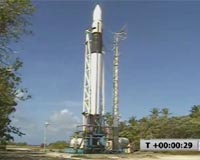
Space X Declares Falcon 1 Testing Complete And Ready For Commercial Orbital Transportation Services
Los Angeles CA (SPX) Mar 29, 2007 Having had several days to examine the data, the second test launch of Falcon 1 is looking increasingly positive. Post flight review of telemetry has verified that oscillation of the second stage late in the mission is the only thing that stopped Falcon 1 from reaching full orbital velocity. The second stage was otherwise functioning well and even deployed the satellite mass simulator ring at the end of flight! Actual final velocity was 5.1 km/s or 11,000 mph, whereas 7.5 km/s or 17,000 mph is needed for orbit. Altitude was confirmed to be 289 km or 180 miles, which is certainly enough for orbit and is about where the Space Shuttle enters its initial parking orbit. This confirms the end of the test phase for Falcon 1 and the beginning of the operational phase. The next Falcon 1 flight will carry the TacSat 1 satellite for the US Navy, with a launch window that begins in September, followed by Razaksat for the Malaysian Space Agency in November. Beyond that, we have another nine missions on manifest for F1 and F9. Note, the first F9 mission will also be a test flight and the three NASA F9/Dragon missions are all test flights for Dragon. Telemetry shows that engine shutdown occurred only about a minute and a half before schedule (roughly T + 7.5 mins), due to the oscillations causing propellant to slosh away from the sump. When the liquid level in the tank was low, this effectively starved the engine of propellant. A disproportionate amount of the velocity gain occurs in the final few minutes of flight, when the stage is very light, which is why the velocity difference is greater than just linearly subtracting 1.5 mins from the burn time. Except for a few blips here and there, we have now cleaned up the raw data feed and recovered video and telemetry for the entire mission well past 2nd stage shutdown. Including all the launch pad video and ground support equipment data, we have somewhere close to a terabyte of information to review. This was far too much to send over the T1 satellite link from Kwaj and had to be brought over in person after the flight. Given that a number of our engineers have only just returned from Kwaj, please consider this still a preliminary analysis: In a nutshell, the data shows that the increasing oscillation of the second stage was likely due to the slosh frequency in the liquid oxygen (LOX) tank coupling with the thrust vector control (engine steering) system. This started out as a pitch-yaw movement and then transitioned into a corkscrewing motion. For those that aren't engineers, imagine holding a bowl of soup and moving it from side to side with small movements, until the entire soup mass is shifting dramatically. Our simulations prior to flight had led us to believe that the control system would be able to damp out slosh, however we had not accounted for the perturbations of a contact on the stage during separation, followed by a hard slew to get back on track. The nozzle impact during stage separation occurred due to a much higher than expected vehicle rotation rate of about 2.5 deg/sec vs. max expected of 0.5 deg/sec. As the 2nd stage nozzle exited the interstage, the first stage was rotating so fast that it contacted the niobium nozzle. There was no apparent damage to the nozzle, which is not a big surprise given that niobium is tough stuff. The unexpectedly high rotation rate was due to not knowing the shutdown transient of the 1st stage engine (Merlin) under flight conditions. The actual shutdown transient had a very high pitch over force, causing five times the max expected rotation rate. We definitely intend to have both the diagnosis and cure vetted by third party experts, however we believe that the slosh issue can be dealt with in short order by adding baffles to our 2nd stage LOX tank and adjusting the control logic. Either approach separately would do the trick (eg. the Atlas-Centaur tank has no baffles), but we want to ensure that this problem never shows up again. The Merlin shutdown transient can be addressed by initiating shutdown at a much lower thrust level, albeit at some risk to engine reusability. Provided we have a good set of slosh baffles, even another nozzle impact at stage separation would not pose a significant flight risk, although obviously we will work hard to avoid that. I will be posting another DemoFlight 2 post launch update within a week, which will include a list of all subsystems color coded for status: green = good, yellow = cause for concern, red = flight failure if unchanged, black = untested. Of the hundreds of subsystems on the rocket, only the 2nd stage LOX tank slosh baffles are clearly red right now, but that could change with further analysis. As much as is reasonably possible (subject to ITAR and proprietary info), SpaceX will provide full disclosure with respect to the findings of the mission review team. The Difference Between a Test Flight and an Operational Satellite Mission There seems to be a lot of confusion in the media about what constitutes a success. The critical distinction is that a test flight has many gradations of success, whereas an operational satellite mission does not. Although we did our best at SpaceX to be clear about last week's launch, including naming it DemoFlight 2 and explicitly not carrying a satellite, a surprising number of people still evaluated the test launch as though it were an operational mission. This is neither fair nor reasonable. Test flights are used to gather data before flying a "real" satellite and the degree of success is a function of how much data is gathered. The problem with our first launch is that, although it taught us a lot about the first stage, ground support equipment and launch pad, we learned very little about the second stage, apart from the avionics bay. However, that first launch was still a partial success, because of what we learned and, as shown by flight two, that knowledge was put to good use: there were no flight critical issues with the first stage on flight two. The reason that flight two can legitimately be called a near complete success as a test flight is that we have excellent data throughout the whole orbit insertion profile, including well past second stage shutdown, and met all of the primary objectives established beforehand by our customer (DARPA/AF). This allows us to wrap up the test phase of the Falcon 1 program and transition to the operational phase, beginning with the TacSat mission at the end of summer. Let me be clear here and now that anything less than orbit for that flight or any Falcon 1 mission with an operational satellite will unequivocally be considered a failure. This is not "spin" or some clever marketing trick, nor is this distinction an invention of SpaceX -- it has existed for decades. The US Air Force made the same distinction a few years ago with the demonstration flight of the Delta IV Heavy, which also carried no primary satellite. Although the Delta IV Heavy fell materially short of its target velocity and released its secondary satellites into an abnormally low altitude, causing reentry in less than one orbit, it was still correctly regarded by Boeing and the Air Force as a successful test launch, because sufficient data was obtained to transition to an operational phase. It is perhaps worth drawing an analogy with more commonplace consumer products. Before software is released, it is beta tested in non-critical applications, where bugs are worked out, before being released for critical applications, although some companies have been a little loose with this rule. :) Cars go through a safety and durability testing phase before being released for production. Rockets may involve rocket science, but are no different in this regard. This report is a public domain press release distributed by Space X. No copyright is attached to this article and maybe freely reproduced without reference to this site. Related Links SPACE X Rocket Science News at Space-Travel.Com Rocket Science News at Space-Travel.Com
 New Launch Of Dnepr Rocket Postponed For Technical Reasons
 Moscow (RIA Novosti) Mar 28, 2007
The first launch following last summer's crash of a Dnepr carrier rocket, scheduled for this month, has been postponed due to technical reasons, a spokesman for the Russian Space Agency said Tuesday. |
|
|

| The content herein, unless otherwise known to be public domain, are Copyright Space.TV Corporation. AFP and UPI Wire Stories are copyright Agence France-Presse and United Press International. ESA Portal Reports are copyright European Space Agency. All NASA sourced material is public domain. Additional copyrights may apply in whole or part to other bona fide parties. Advertising does not imply endorsement, agreement or approval of any opinions, statements or information provided by Space.TV Corp on any Web page published or hosted by Space.TV Corp. Privacy Statement |