SPACE TRAVEL SPACE DAILY SPACE WAR TERRA DAILY MARS DAILY SPACE MART GPS DAILY ENERGY DAILY
  Space Travel News  
Get Our Free Newsletters Via Email
  
Search All Our Sites at SpaceBank
Rocket Motor Test Helps NASA's Shuttle And Ares I

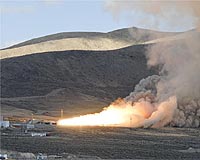
NASA's static firing of a full-scale, full-duration flight support motor was performed at 7 p.m. CST on Nov. 16 at ATK Launch Systems Group, a unit of Alliant Techsystems Inc. in Promontory, Utah, where the shuttle's solid rocket motors are manufactured. The flight support motor burned for approximately 123 seconds, the same duration each reusable solid rocket motor burns during an actual space shuttle launch. The Reusable Solid Rocket Motor Project Office at NASA's Marshall Space Flight Center in Huntsville, Ala., manages these tests to qualify any proposed changes to the rocket motor and to determine whether new materials perform as well as those now in use. Image credit: ATK.
by Staff Writers
Promontory UT (SPX) Nov 19, 2006
NASA's Space Shuttle Program successfully fired a reusable solid rocket motor Thursday, Nov. 16, at a Utah facility. The two-minute test provided important information for nighttime shuttle launches and for the development of the rocket that will carry the next human spacecraft to the moon.

The static firing of the full-scale, full-duration flight support motor was performed at 6 p.m. MST at ATK Launch Systems Group, a unit of Alliant Techsystems Inc. in Promontory, Utah, where the shuttle's solid rocket motors are manufactured.

The flight support motor, or FSM-13, burned for approximately 123 seconds, the same time each reusable solid rocket motor burns during an actual space shuttle launch. The Reusable Solid Rocket Motor Project Office at NASA's Marshall Space Flight Center in Huntsville, Ala., manages these tests to qualify any proposed changes to the rocket motor and to determine whether new materials perform as well as those now in use.

The motor firing also provided the Space Shuttle Program with data on how image quality is affected by night launch conditions. The data will help determine camera settings and techniques that are most suitable for future night shuttle launches and those which could possibly enhance imagery gathered during a day launch.

"Full-scale static testing such as this is a key element of the 'test before you fly' standard and ensures continued quality and performance," said Jody Singer, manager of the Reusable Solid Rocket Motor Project, part of the Space Shuttle Propulsion Office at Marshall.

The shuttle solid rocket motor firing also supports NASA's future exploration goals to return humans to the moon. The test provided data for development of the first stage reusable solid rocket motor for NASA's Ares I, the launch vehicle that will carry the Orion crew module to space. Engineers with NASA's Exploration Launch Projects Office at Marshall, which manages the Ares launch vehicles, will analyze motor-induced, roll-torque measurements. The information - how the motor affects the rotation and twisting of a system - is needed for the Ares I control system design.

Thursday night's test provided data on numerous process, material and design changes planned for shuttle solid rocket motors, including a propellant structural redesign that more evenly distributes loads and improves safety during storage and transportation; an improved adhesive bonding process to eliminate insulation voids and increase bond strength; and a new nozzle liner material to replace a material that is no longer available. Stress data was also gathered on an instrumented external tank attachment ring, which connects the solid rocket booster to the shuttle's external fuel tank.

Preliminary indications are that all test objectives were met. After final test data are analyzed, results for each objective will be published by NASA in a report that will be available early next year.

The shuttle's reusable solid rocket motor is the largest solid rocket motor ever flown, the only one rated for human flight and the first designed for reuse. Each shuttle launch requires two reusable solid rocket motors to lift the 4.5-million-pound shuttle. The motors provide 80 percent of the thrust during the first two minutes of flight. Each motor, just over 126 feet long and 12 feet in diameter, generates an average thrust of 2.6 million pounds. It is the primary component of the shuttle's twin solid rocket boosters.

During a shuttle launch, the rockets take the shuttle to an altitude of 28 miles at a speed of 3,094 mph before they separate and fall into the ocean. Then they are retrieved, refurbished and prepared for another flight.

Regular static-fire tests of the motors help maintain the highest safety, quality and reliability standards of solid rocket motors used for human spaceflight. Engineers conduct approximately 110,000 quality-control inspections on each motor designed for flight.

Related Links
Ares 1 at NASA
Rocket Science News at Space-Travel.Com

Air Force Advances Space Vehicle Development
Washington DC (SPX) Nov 19, 2006
The U.S. Air Force is developing an Orbital Test Vehicle, based on the design of a NASA X-37 technology demonstrator, to continue full-scale development and on-orbit testing of an unmanned long-duration, reusable space vehicle. The new OTV effort takes advantage of industry and government investments by Air Force, NASA, and the Defense Advanced Research Projects Agency.

   Add to Delicious


Memory Foam Mattress Review

Newsletters :: SpaceDaily Express :: SpaceWar Express :: TerraDaily Express :: Energy Daily
XML Feeds :: Space News :: Earth News :: War News :: Solar Energy News
  • Rocket Motor Test Helps NASA's Shuttle And Ares I
  • Boeing Signed On the Evolved Expendable Launch Vehicle Rocket Program
  • Air Force Advances Space Vehicle Development
  • Jim Halsell Joins ATK As VP and Program Manager Of ARES I Upper Stage

  • Soyuz Booster Rocket Launches From Kourou To Cost 50 Million Dollars
  • Government To Consider Accord On Soyuz Launch From Kourou
  • ILS Proton Successfully Launches ARABSAT BADR-4 Satellite
  • TerreStar Networks Chooses Arianespace to Launch TerreStar I

  • Her Time For Discovery
  • Shuttle Crew Arrives For Dress Rehearsal
  • Discovery Rolls Out To Launch Pad 39B
  • Night Shuttle Launch Will Not Prevent Debris Detection

  • ISS Crew Getting Ready For Golf Day
  • ISS Cosmonaut Tyurin To Play Golf In Outer Space
  • ISS Crew Looking Forward To An Excursion
  • ISS Crew Begins Robotics Proficiency Work

  • Roscomos Confirms Green Light For E21 Golf Company Golf Shot In Space
  • NASA Completes Milestone Review Of Next Human Spacecraft System
  • India's First Cosmonaut Ready To Go To Space Again
  • First Research Confirms That Eating Slowly Inhibits Appetite

  • China's First Ever Space Textbook Published
  • Steppin' Out From Shenzhou
  • China To Build Space Station Eventually
  • China Proceeding With Assembly Shenzhou 7 Spacecraft

  • A Robot Invention With A Leg To Stand On
  • Making Robotic Movement Of Goods More 'Pallet-Able'
  • Receptionist And Porter Robots Make Debut At Japanese Hospital
  • iRobot Unveils New Technology For Simultaneous Control Of Multiple Robots

  • NASA's Newest Mars Orbiter Passes Communications Relay Test
  • NASA's Red Planet 'Photographer' Jim Bell Presents 'Postcards From Mars'
  • Piecing Together Life's Potential
  • Opportunity On The Move After Solar Conjunction

  • The content herein, unless otherwise known to be public domain, are Copyright 1995-2006 - SpaceDaily.AFP and UPI Wire Stories are copyright Agence France-Presse and United Press International. ESA PortalReports are copyright European Space Agency. All NASA sourced material is public domain. Additionalcopyrights may apply in whole or part to other bona fide parties. Advertising does not imply endorsement,agreement or approval of any opinions, statements or information provided by SpaceDaily on any Web page published or hosted by SpaceDaily. Privacy Statement