
 |
 |
 |
 |
 |
 |
 |
 |
 |

 |

Raleigh NC (SPX) Apr 07, 2011 Researchers from North Carolina State University have investigated the viability of a technique called "spincasting" for creating thin films of nanoparticles on an underlying substrate - an important step in the creation of materials with a variety of uses, from optics to electronics. Spincasting, which utilizes centrifugal force to distribute a liquid onto a solid substrate, already has a variety of uses. For example, it is used in the electronics industry to deposit organic thin films on silicon wafers to create transistors. For this study, the researchers first dispersed magnetic nanoparticles coated with ligands into a solution. The ligands, small organic molecules that bond directly to metals, facilitate the even distribution of the nanoparticles in the solution - and, later, on the substrate itself. A drop of the solution was then placed on a silicon chip that had been coated with a layer of silicon nitride. The chip was then rotated at high speed, which spread the nanoparticle solution over the surface of the chip. As the solution dried, a thin layer of nanoparticles was left on the surface of the substrate. Using this technique, the researchers were able to create an ordered layer of nanoparticles on the substrate, over an area covering a few square microns. "The results are promising, and this approach definitely merits further investigation," says Dr. Joe Tracy, an assistant professor of materials science and engineering at NC State and co-author of a paper describing the study. Tracy explains that one benefit of spincasting is that it is a relatively quick way to deposit a layer of nanoparticles. "It also has commercial potential as a cost-effective way of creating nanoparticle thin films," Tracy says. However, the approach still faces several hurdles. Tracy notes that modifications to the technique are needed, so that it can be used to coat a larger surface area with nanoparticles. Additional research is also needed to learn how, or whether, the technique can be modified to achieve a more even distribution of nanoparticles over that surface area. Analysis of the nanoparticle films created using spincasting led to another development as well. The researchers adapted analytical tools to evaluate transmission electron microscopy images of the films they created. One benefit of using these graphical tools is their ability to identify and highlight defects in the crystalline structure of the layer. "These methods for image analysis allow us to gain a detailed understanding of how the nanoparticle size and shape distributions affect packing into monolayers," Tracy says. The paper, "Formation and Grain Analysis of Spin Cast Magnetic Nanoparticle Monolayers," was published online March 24 by the journal Langmuir. The paper was co-authored by Tracy; NC State Ph.D. student Aaron Johnston-Peck; and former NC State post-doctoral research associate Dr. Junwei Wang. The research was funded by the National Science Foundation, the U.S. Department of Education, and Protochips, Inc.
Share This Article With Planet Earth
Related Links North Carolina State University Nano Technology News From SpaceMart.com Computer Chip Architecture, Technology and Manufacture

 Major Advance In Understanding How Nanowires Form
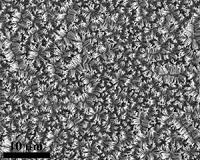
Copenhagen, Denmark (SPX) Apr 04, 2011 insights into why and how nanowires take the form they do will have profound implications for the development of future electronic components. PhD student Peter Krogstrup from the Nano-Science Center at the University of Copenhagen is behind the sensational new theoretical model, which is developed in collaboration with researchers from CINAM-CNRS in Marseille. One of the most important co ... read more |
|
|
| The content herein, unless otherwise known to be public domain, are Copyright 1995-2010 - SpaceDaily. AFP and UPI Wire Stories are copyright Agence France-Presse and United Press International. ESA Portal Reports are copyright European Space Agency. All NASA sourced material is public domain. Additional copyrights may apply in whole or part to other bona fide parties. Advertising does not imply endorsement,agreement or approval of any opinions, statements or information provided by SpaceDaily on any Web page published or hosted by SpaceDaily. Privacy Statement |


 del.icio.us
 Digg
Digg Reddit
 YahooMyWeb
 Google
 Facebook


