 |
 |
 |
 |
 |
 |
 |
 |
 |

 |
New Collaborative Research Reveals Chimpanzees Can Sustain Multiple-Tradition Cultures
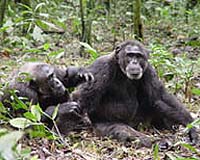
Scotland UK (SPX) Jun 11, 2007 Scientists have long wondered if local animal cultures exist, and now, based on findings by researchers at the Yerkes National Primate Research Center at Emory University, the University of Texas and St. Andrews University, Scotland, they have their answer: Yes. The study, available in the latest online edition of Current Biology, confirms captive chimpanzees have the capacity to sustain the same kind of multiple-tradition cultures many researchers believe exist in the wild, providing further evidence chimpanzees and humans shared a common ancestor five to six million years ago who had a similar level of cultural complexity. For years, primatologists have suggested different communities of chimpanzees across Africa vary in many behavior patterns, indicating they have cultures specific to each community. In the wild, however, it is difficult to prove behaviors are passed on by observation and learning. In this study, members of the international collaborative research team taught forms of tool use and food extraction techniques to high-ranking individuals in four different captive chimpanzee communities. Researchers then observed as those individuals passed on the techniques to other members of their communities. The researchers included Frans de Waal, PhD, Victoria Horner, PhD, and Kristin Bonnie from the Yerkes Research Center, lead researchers Andrew Whiten, PhD, and Antoine Spireti from St. Andrews University, and Susan Lambeth, PhD, and Steven Schapiro, PhD, from the University of Texas. In the Yerkes-based portion of the study, Dr. de Waal, Dr. Horner and Dr. Bonnie worked with two chimpanzee groups and introduced each to one of two alternative sequences of complex behaviors. The sequences included collecting, transporting and depositing a token into a bucket or a pipe to receive a food reward from a separate, unrelated location. After each group of chimpanzees observed a high-ranking female member of its own group complete an action sequence, the majority of the chimpanzees followed that sequence for the remainder of the testing period. Over time, the different methods chosen by each high-ranking female were passed among members of her group, thereby becoming a local tradition. In all, the researchers observed 10 traditions spread throughout the chimpanzee groups at the Yerkes Research Center and the University of Texas. "This study nicely summarizes our collaborative work of the last five years, showing we can artificially introduce cultures in chimpanzees, which supports the idea cultural variation observed in the wild is learned," says Dr. de Waal. "We are the first to show cultures potentially can jump from group to group if you offer chimpanzees the opportunity to watch other groups. It's a bit like Westerners learning to eat with chopsticks." Related Links Yerkes National Primate Research Center Darwin Today At TerraDaily.com
 Threats To Wild Tigers Growing
 Washington DC (SPX) Jun 05, 2007
The wild tiger now occupies a mere 7 percent of its historic range, and the area known to be inhabited by tigers has declined by 41 percent over the past decade, according to an article published in the June 2007 issue of BioScience. Growing trade in folk medicines made from tiger parts and tiger skins, along with habitat loss and fragmentation, is believed to be the chief reason for the losses. |
|
|

| The content herein, unless otherwise known to be public domain, are Copyright Space.TV Corporation. AFP and UPI Wire Stories are copyright Agence France-Presse and United Press International. ESA Portal Reports are copyright European Space Agency. All NASA sourced material is public domain. Additional copyrights may apply in whole or part to other bona fide parties. Advertising does not imply endorsement, agreement or approval of any opinions, statements or information provided by Space.TV Corp on any Web page published or hosted by Space.TV Corp. Privacy Statement |