
 |
 |
 |
 |
 |
 |
 |
 |
 |

 |

Davis, Calif. (UPI) Feb 24, 2011 A search for a missing metal in the Earth could help scientists understand the early stages of planet formation, U.S. researchers say. Scientists studying the element chromium have known for years that the element's isotopes are relatively underrepresented in the Earth's mantle and crust, and the question has been whether they were volatile and disappeared into space in the planet's early period or got sucked in the Earth's deep core at some point. University of California, Davis, geology professor Qing-Zhu Yin and others compared measurements of chromium isotopes in meteors with levels found in the Earth's crust. The meteorites studied are from a class called chondrites, left over from the formation of the solar system more than 4.5 billion years ago, a UC Davis release said Thursday. From the comparisons the researchers were able to determine that some forms of the element chromium separated and disappeared deep into the planet's core, and some 65 percent of the "missing" chromium is most likely in the Earth's core. The separation must have happened early in the planet building process, the researchers say, probably in the multiple smaller bodies that assembled into the Earth or when the Earth was still molten but smaller than today.
Share This Article With Planet Earth
Related Links Lands Beyond Beyond - extra solar planets - news and science Life Beyond Earth

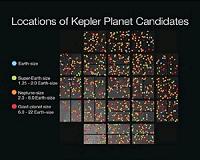 Kepler Triples ExoPlanet Count As Search For Biosphere 2 Intensifies
Eureka, CA (SPX) Feb 21, 2011 The rush of data released earlier this month from the Kepler science team is intriguing for what it saw and didn't see in its first 4 months of observations. The relatively small Kepler space telescope is very good at what it does. It has a highly sensitive array of CCDs (light sensors) that has taken about 21 months of data. We saw the release of a small part of that data recently. It rev ... read more |
|
|
| The content herein, unless otherwise known to be public domain, are Copyright 1995-2010 - SpaceDaily. AFP and UPI Wire Stories are copyright Agence France-Presse and United Press International. ESA Portal Reports are copyright European Space Agency. All NASA sourced material is public domain. Additional copyrights may apply in whole or part to other bona fide parties. Advertising does not imply endorsement,agreement or approval of any opinions, statements or information provided by SpaceDaily on any Web page published or hosted by SpaceDaily. Privacy Statement |


 del.icio.us
 Digg
Digg Reddit
 YahooMyWeb
 Google
 Facebook


