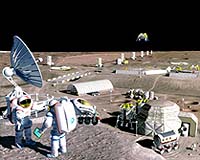
Lunar base.
Lunar base. |
The 'Humans in Outer Space - Interdisciplinary Odysseys' conference recently held in Vienna was the first such forum where scholars from a humanities background together with scientists could discuss humankind's presence in space from non-traditional perspectives.
The benefits of creating such a cross-disciplinary forum is that it was able to give guiding insight into how humankind will face possible issues, issues that can be best addressed in the light of modern understanding of historical events.
Some of the wide-ranging issues that conference delegates explored include the philosophical and theological consequences of contacting alien intelligences, the marketing of space exploration, and the legal frameworks that will be needed if space-faring nations are to cooperate peacefully.
The event was organised in part by an ESF Steering Committee chaired by Professor Luca Codignola, a historian at the University of Genoa. At the conference he expressed his interest in what history can tell us about the challenges we may face if space explorers make contact with alien civilisations.
Delving into history for an example, he drew correlations with the so-called "Columbian Exchange" that took place around 1492. 'It changed the Western way of conceiving the globe; it forcefully challenged its theology; it allowed for a free flow of bacteria, germs and microbes that almost wiped out the American peoples,' he explained.
'The science community does not really seem to be aware of the fact that a number of issues and concerns that they are dealing with, such as the consequences of meeting with unknown pathogens, are known and have long been studied by historians and ethnologists,' Prof. Codignola offered.
'As for the humanities scholars, technical difficulties relating to space-voyaging and especially its timeframe, usually escape them. We all felt it was rather strange that the two groups rarely, if ever, meet to discuss space-related issues,' he added.
The conclusions from these sessions will be documented by the ESF in a position paper entitled 'Vienna Vision on Humans in Outer Space'. The ESF will distribute this paper to all interested stakeholders in the academic world, space agencies, intergovernmental bodies such as the United Nations, the media and politicians involved in space- and research-related initiatives.
Prof. Kai-Uwe Schrogl, Secretary General of the ESPI and Chair of the conference, commented: 'Mankind's future in outer space will require a comprehensive view, including the input in particular by the humanities and social sciences, as well as the reflection of the manifold trans-utilitarian aspects that make space exploration a province of all mankind.'
The conference was jointly arranged by the European Science Foundation (ESF), the European Space Agency (ESA) and the European Space Policy Institute (ESPI).
Related Links
 Chinese Taikonauts May Build Communist Party Branch In Space
 Beijing, China (XNA) Oct 19, 2007
| The content herein, unless otherwise known to be public domain, are Copyright Space.TV Corporation. AFP and UPI Wire Stories are copyright Agence France-Presse and United Press International. ESA Portal Reports are copyright European Space Agency. All NASA sourced material is public domain. Additional copyrights may apply in whole or part to other bona fide parties. Advertising does not imply endorsement, agreement or approval of any opinions, statements or information provided by Space.TV Corp on any Web page published or hosted by Space.TV Corp. Privacy Statement |