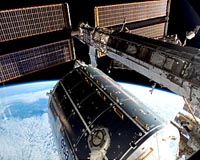
In May 2009, Frank De Winne, of Belgian nationality and a member of the European Astronaut Corps, will fly to the International Space Station at the start of his six-month mission. This mission sees him become the first European commander of the Station by October 2009. ESA has now given his mission the name OasISS.
During his stay on the International Space Station (ISS), De Winne will conduct scientific experiments developed by scientists from different European countries and others worldwide. In addition he will perform technology demonstrations and an education programme. De Winne will also be instrumental in operating the Station's robotic arm and that of the Kibo module, to help install the external payloads for the Japanese laboratory.
OasISS, the second European long-term mission to the ISS, will enlarge the crew of the ISS to six astronauts for the first time and thereby increase the time available for scientific experiments. It is a visible sign of the important role Europe plays through ESA in human spaceflight and in human exploration.
The name was chosen by ESA from 520 suggestions received in response to a competition launched by ESA's Directorate of Human Spaceflight last September. "I am very pleased with the interest the mission name competition has received from many people in all ESA Member States. It shows that human spaceflight is attractive and important for a lot of Europeans," says De Winne.
"The selected name represents the spirit of human exploration and addresses all the aspects set out in the competition brief, including the importance of water for human life. I would like to thank everybody who spent their time and creativity to contribute to finding the name. I am proud that my mission carries a name proposed by a European citizen."
The winning name refers to many aspects of the International Space Station as well as to human exploration, ranging from the exploration of deserts on Earth by European explorers, to the deserts we will find on other planets, where humankind might be able set up an oasis and provide a permanent human outpost to live on that planet.
The ISS itself can be considered an oasis in space for its astronauts and cosmonauts, whilst the Earth is often referred to as the Blue Planet and represents an oasis for humankind in the Universe. The name also refers to the challenge to find an oasis, where human exploration is a challenge in itself.
OasISS also ties in with De Winne's role as a goodwill ambassador for UNICEF Belgium. In support of the UNICEF 2009 WASH campaign dedicated to water, sanitation and hygiene, several events will be implemented during his flight to draw public attention to the availability and cleanliness of water which is critically important for human life.
"Water is a scarce resource on board the ISS; responsible use and recycling in space can help develop efficient water processing applications for Earth, which are particularly important for the developing countries," explains De Winne.
The winning mission name, OasISS, was proposed by Jan Puylaert from Ghent, in Belgium.