 |
 |
 |
 |
 |
 |
 |
 |
 |

 |
United Launch Alliance Launches GeoEye-1 Commercial Satellite
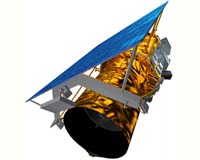
Vandenberg AFB CA (SPX) Sep 08, 2008 An United Launch Alliance Delta II rocket, on behalf of Boeing Launch Systems, successfully launched the GeoEye-1 satellite. Blasting off from Space Launch Complex 2 here, it marked the second ULA Delta II mission from Vandenberg in 2008. GeoEye-1 will provide the highest resolution of any commercial imaging system -- 0.41-meters or 16 inches for panchromatic (black and white) imagery and multispectral (color) imagery at 1.65-meter resolution. Following a nearly 59 minute flight, the GeoEye-1 spacecraft was deployed on its mission equipped with the most advanced and sophisticated technology, capable of offering three-meter accuracy. This allows end users to map natural and man-made features to within three meters of their actual locations on the surface of the Earth without ground control points. "ULA is pleased to have successfully launched the GeoEye-1 satellite for our GeoEye and Boeing Launch Systems customers," said Jim Sponnick, ULA vice president, Delta Product Line. "We are excited to be part of the team that built and launched this advanced satellite technology, which will ultimately provide the highest-resolution view of our home planet ever available to scientists, businesses, the US government, and private citizens." The ULA Delta II 7420-10 configuration vehicle featured a first stage booster powered by a Pratt and Whitney Rocketdyne RS-27A main engine and four Alliant Techsystems (ATK) strap-on solid rocket motors. An Aerojet AJ10-118K engine powered the second stage. The payload was encased by a 10-foot-diameter composite payload fairing. The vehicle guidance and navigation system for the Delta launch vehicles is provided by L-3 Space and Navigation's Redundant Inertial Flight Control Assembly (RIFCA). "On behalf of the United Launch Alliance, I congratulate L-3 Communications on their outstanding achievement of the 100th consecutive successful RIFCA flight on this GeoEye-1 mission," said Sponnick. "The launch was a significant milestone for our L-3 partners after a long history of support to the Delta II, Delta III, and Delta IV vehicles." ULA began assembling the Delta II launch vehicle in Decatur, Ala., nearly two years ago. In late May the first stage arrived here from Decatur, followed by the second stage in June. The vehicle was erected on the stand at SLC-2, July 3, with solid rocket motor installation completed by July 9. The GeoEye-1 spacecraft was mated to the Delta II booster Aug. 7. ULA's next launch is a National Reconnaissance office mission scheduled for Oct. 17, from Cape Canaveral Air Force Station, Fla., aboard a Delta IV Heavy from SLC-37. Related Links United Launch Alliance Launch Pad at Space-Travel.com
 Aurora Signs Contract To Build Minotaur IV Composite Structures
 Manassas VA (SPX) Sep 05, 2008
Aurora Flight Sciences has announced that it has been awarded a contract from Orbital to build Minotaur IV Composite Structures. |
|
|

| The content herein, unless otherwise known to be public domain, are Copyright Space.TV Corporation. AFP and UPI Wire Stories are copyright Agence France-Presse and United Press International. ESA Portal Reports are copyright European Space Agency. All NASA sourced material is public domain. Additional copyrights may apply in whole or part to other bona fide parties. Advertising does not imply endorsement, agreement or approval of any opinions, statements or information provided by Space.TV Corp on any Web page published or hosted by Space.TV Corp. Privacy Statement |