
SPACE TRAVEL SPACE DAILY SPACE WAR TERRA DAILY MARS DAILY SPACE MART GPS DAILY ENERGY DAILY
  Space Travel News  
Get Our Free Newsletters Via Email
  
Search All Our Sites at SpaceBank
Research Continues For Deep Space Travel Propulsion

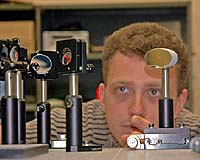
A graduate student watches a Plasmoid Thruster Experiment on the campus of The University of Alabama in Huntsville.
by Staff Writers
Huntsville AL (SPX) Jan 16, 2007
Graduate students and faculty researchers at The University of Alabama in Huntsville are investigating propulsion concepts that could eventually revolutionize deep space travel. The Plasmoid Thruster Experiment (PTX) is a stepping stone to a highly efficient propulsion concept which could ultimately change how we travel in space, according to Dr. Jason Cassibry, a researcher in UAH's Propulsion Research Center.

"Larger, more powerful versions can produce fusion for both power and space propulsion, allowing human travel to the outer planets," he said.

Few groups around the country are working on this emerging technology, according to Cassibry. UAH is among that small number of research institutions.

The experimental branch of the Propulsion Research Center's pulsed plasma research group is focused on gathering experimental data from PTX, which was originally built at NASA's Marshall Space Flight Center. MSFC donated the equipment to UAH last year.

The purpose of the PTX is to investigate the fundamental plasma and acceleration properties of a small-scale, pulsed plasma thruster.

PTX works by ringing a single turn conical theta pinch coil at about 500 kHz, ionizing and accelerating a small quantity of gas. The magnetic field inside the coil creates a plasmoid, a plasma that has a closed magnetic field structure.

One of the biggest challenges in any electric propulsion concept is increasing the lifetime of the thruster, which must run continuously for several years for deep space missions. Most electric propulsion concepts use plasma, which is in contact with electrodes or acceleration grids, causing erosion of the components and limiting the lifetime of the thruster. The plasmoid thruster potentially has a much longer lifetime, because the plasma is formed inductively, which means that the plasma is not in contact with the thruster components.

UAH researchers ran system tests and calibrations in October, and today the equipment is at full capacity.

In the short term, PTX will continue to take data in support of the ongoing development of the numerical models. This will be accomplished by using a laser interferometer to measure the plasma density. Also, magnetic field measurements help to determine size of the plasmoid. Together, these diagnostics provide a lot of information without affecting the plasmoid itself, according to Cassibry.

In the long term, the PTX experiment will be expanded by varying the coil geometry, adding bias flux and changing the initial conditions to study the effect on the coupling efficiency between the primary coil current and the secondary current in the plasmoid in an effort to improve plasma acceleration and thrust.

"Our experimental pulsed plasma group is keeping a watchful eye on the field of plasma science," Cassibry said. "We believe that we now have the means and the ability to support further scientific developments in this field."

Related Links
University of Alabama Huntsville
Rocket Science News at Space-Travel.Com
All about the technology of space and more

Gravity Mission To Benefit From QinetiQ Precision
Paris, France (SPX) Jan 15, 2007
QinetiQ has conducted the final testing of its T5 ion thrusters that will enable a European space mission to measure and map the Earth's gravity field in far greater detail than ever previously achieved. QinetiQ's T5 ion thrusters will provide high precision drag compensation for the European Space Agency (ESA) GOCE spacecraft, due for launch later this year. The data captured by GOCE will contribute significantly to our understanding of the Earth's structure, climate and the impacts of climate change.

   Add to Delicious


Memory Foam Mattress Review

Newsletters :: SpaceDaily Express :: SpaceWar Express :: TerraDaily Express :: Energy Daily
XML Feeds :: Space News :: Earth News :: War News :: Solar Energy News
  • Research Continues For Deep Space Travel Propulsion
  • Gravity Mission To Benefit From QinetiQ Precision
  • Russian Space Truck Arrives On Train From Factory
  • NASA Completes Review Milestone For Ares I Vehicle

  • Launch Window To Open At Poker Flat Research Range
  • All Four Satellites In Healthy Condition After PSLV Launch
  • India Tests Technology For Space Vehicles
  • PSLV Successfully Launches Four Satellites

  • Holloman Forces Trained, Ready For Possible Shuttle Landing
  • Crew Inspecting Heat Shield, Preparing for Landing
  • Bad Weather Could Force Shuttle Discovery To Land In Western US
  • Astronauts Stow Stubborn Solar Array

  • ISS Takes Out The Trash
  • Draper-Developed Trajectory Maneuvers ISS Without Using Propellant
  • To The Space Station And Beyond In High Definition
  • Three Makes For A Crowd This New Year In Space

  • Starchaser Industries Wins European Space Agency Contract
  • Russia And Europe Join Forces In Space
  • Europe Forges Long-Term Strategy For Space Exploration
  • Eileen Collins: An Astronaut's Endless Endeavor

  • China Upgrades Satellite Launch Tower
  • China Reports Breakthrough In Space Determination And Control Technology
  • China To Launch 6 Geographical Survey Satellites
  • China Enhances Spacecraft Monitoring Network

  • Hunt On For Next World-Changing Gadget At US Electronics Show
  • NASA Awaits New FIRST Robotics Season
  • Futuristic Tools And Toys At Largest Consumer Electronics Show
  • Robotic Crawler Detects Wear In Power Lines

  • Opportunity Finds Another Meteorite
  • Spirit Continues To Test New Computer Smarts
  • MRO Conducts Details Survery Of Mars Pathfinder Landing Site And Surroundings
  • NASA Funds Scripps Instrument For Probing For Life On Mars

  • The content herein, unless otherwise known to be public domain, are Copyright 1995-2006 - SpaceDaily.AFP and UPI Wire Stories are copyright Agence France-Presse and United Press International. ESA PortalReports are copyright European Space Agency. All NASA sourced material is public domain. Additionalcopyrights may apply in whole or part to other bona fide parties. Advertising does not imply endorsement,agreement or approval of any opinions, statements or information provided by SpaceDaily on any Web page published or hosted by SpaceDaily. Privacy Statement