 |
 |
 |
 |
 |
 |
 |
 |
 |

 |
NASA Selects Prime Contractor For Ares I Rocket Avionics
Washington DC (SPX) Dec 13, 2007 NASA has selected The Boeing Company of Huntsville, Ala., as the prime contractor to produce, deliver and install avionics systems for the Ares I rocket that will launch the Orion crew exploration vehicle into orbit. The selection is the final major contract award for Ares I. The award resulted from a full and open competition. The Ares I launch vehicle is a key component of the Constellation Program, which will send humans to the moon by 2020 to set up a lunar outpost. Boeing will support the NASA design team leading the development of the Ares I avionics components. The company also will develop and acquire avionics hardware for the rocket and assemble, inspect and integrate the avionics system components on the upper stage. Components will be manufactured by the prime contractor's suppliers across the country. Final integration and checkout will take place at NASA's Michoud Assembly Facility in Louisiana. The avionics are the "brains" of the Ares I and will provide guidance, navigation and control for the rocket until it reaches orbit. The avionics system is responsible for managing vehicle health and reporting it to flight controllers based on a sequence of timed events, such as engine shutdown and first stage separation. The instrument unit that contains the bulk of the avionics will be situated between the two-stage Ares I rocket and the adapter that joins Ares I to the Orion spacecraft. The system consists of onboard computers, flight controls, communications equipment and other instruments and software for monitoring and adjusting the rocket's speed and position during flight. Boeing will provide one instrument unit avionics ground test article, three flight test units and six production flight units to support integrated flight tests and missions through 2016. The contract type is cost-plus-award-fee and the period of performance is Dec. 17, 2007, through Dec. 16, 2016. The estimated value for support to the NASA-led design team and production of test and flight units is $265,489,783. Additional tasks not included in the initial scope of the contract may be acquired up to a maximum value of $420 million. Additional flight units may be obtained at an estimated cost of $114,045,292 for as many as 12 additional units. The total estimated contract value is $799,535,079. The Ares I first stage will be a five-segment solid rocket booster. The upper, second stage of the rocket will consist of a J-2X liquid-oxygen, liquid-hydrogen main engine, a new upper stage fuel tank, and the instrument unit avionics. Related Links NASA's Constellation Program Rocket Science News at Space-Travel.Com
 Russian Carrier Rocket Proton Puts Military Satellite Into Orbit
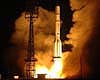 Moscow (RIA Novosti) Dec 10, 2007
A Russian Proton-M carrier rocket, launched from the Baikonur space center in Kazakhstan, has put a military satellite into orbit, Russia's space agency (Roskosmos) said on Sunday. "A Proton-M carrier rocket, which was launched from the Baikonur space center at 03: 16 a.m. Moscow time (00:16 a.m. GMT) today [on Sunday], successfully put a Kosmos satellite into orbit at 12:17 p.m. Moscow time (09:17 a.m. GMT)," Roskosmos said. |
|
|

| The content herein, unless otherwise known to be public domain, are Copyright Space.TV Corporation. AFP and UPI Wire Stories are copyright Agence France-Presse and United Press International. ESA Portal Reports are copyright European Space Agency. All NASA sourced material is public domain. Additional copyrights may apply in whole or part to other bona fide parties. Advertising does not imply endorsement, agreement or approval of any opinions, statements or information provided by Space.TV Corp on any Web page published or hosted by Space.TV Corp. Privacy Statement |