 |
 |
 |
 |
 |
 |
 |
 |
 |

 |
Electric Sail Invention Approaches Implementation
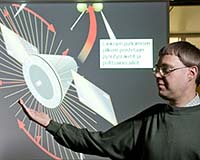
Helsinki, Finland (SPX) Apr 16, 2008 The electric solar wind sail developed at the Finnish Meteorological Institute has moved in a rapidly pace from invention towards implementation. Electric sail propulsion might have a large impact on space research and moving in space more generally. The electric solar wind sail developed by Dr. Pekka Janhunen at the Finnish Meteorological Institute might revolutionise moving around in deep space. The electric sail is a Finnish invention which uses the solar wind as its thrust source and therefore needs no fuel or propellant. The solar wind is a continuous plasma stream emanating from the Sun. Changes in the properties of the solar wind cause auroral brightening and magnetic storms, among other things.
Progress without problems The solar wind exerts a small but continuous thrust on the tethers and the spacecraft. The electric sail and its applications have been developed mainly at the Finnish Meteorological Institute, but component work is carried out at the University of Helsinki and in Germany, Sweden, Russia and Italy. "We haven't encountered major problems in any of the technical fields thus far. This has already enabled us to already start planning the first test mission", says Dr. Pekka Janhunen. An important subgoal was reached when the Electronics Research Laboratory of the University of Helsinki managed to develop a method for constructing a multiline micrometeoroid-resistant tether out of very thin metal wires using ultrasonic welding. The newly developed technique allows the bonding together of thin metal wires in any geometry; thus, the method might also have spinoff applications outside the electric sail.
Potential important applications of the electric sail "The electric sail might cheapen all space activities and thereby for example help making large solar power satellites a viable option for clean electricity production. Solar power satellites orbiting in the permanent sunshine of space could transmit electric power to Earth by microwaves without interruptions. Continuous power would be a major benefit compared to e.g. ground-based solar power where storing the energy over night, cloudy weather and winter are tricky issues especially here in the far North", says Dr. Pekka Janhunen. The electric sail was invented as a byproduct of basic research done at the Finnish Meteorological Institute of the interaction of the solar wind with planets and their atmospheres. Work of the electric sail in Finland is currently funded by the Academy of Finland and private foundations. Related Links Finnish Meteorological Institute Space Tourism, Space Transport and Space Exploration News
 NASA's Marshall Center Readies Historic, Apollo-Era Test Stand For Testing Of Ares I
 Huntsville AL (SPX) Apr 15, 2008
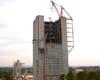
Engineers have begun preparations to renovate the historic, 360-foot-high Saturn V Dynamic Test Stand at NASA's Marshall Space Flight Center in Huntsville. The test stand, used in the 1960s to test the Apollo-era Saturn V rocket and later the integrated space shuttle system, soon will be used for the integrated vehicle ground vibration test of the nation's new Ares I rocket and Orion crew capsule. |
|
|

| The content herein, unless otherwise known to be public domain, are Copyright Space.TV Corporation. AFP and UPI Wire Stories are copyright Agence France-Presse and United Press International. ESA Portal Reports are copyright European Space Agency. All NASA sourced material is public domain. Additional copyrights may apply in whole or part to other bona fide parties. Advertising does not imply endorsement, agreement or approval of any opinions, statements or information provided by Space.TV Corp on any Web page published or hosted by Space.TV Corp. Privacy Statement |