 |
 |
 |
 |
 |
 |
 |
 |
 |

 |
Dawn Of A Long Voyage To The Beginning Of Sol And Beyond
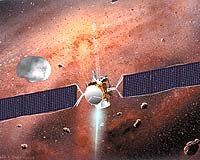
Project System Engineer, JPL Pasadena CA (JPL) Oct 03, 2007 The Dawn project welcomes you to deep space! Dawn is operating smoothly on the fourth day of its 8-year adventure. Like new parents, its extremely proud and greatly sleep-deprived Earthbound mission operations team is carefully monitoring its every move. Launch had been targeted for September 26, but during its last few days on Earth, Dawn continued to be subjected to the vagaries of the weather on that dynamic planet. The second stage of the Delta II 7925H-9.5 rocket had been scheduled to have its second stage filled with propellants on September 23. The nitrogen tetroxide was pumped in before bad weather prevented further activities at Cape Canaveral's Space Launch Complex 17B, so Dawn waited patiently and safely inside the protective payload fairing, or nose cone, of the rocket. On September 24 a delicious blend of hydrazine and unsymmetrical dimethylhydrazine (together known as Aerozine-50) was loaded as the countdown resumed, targeted for launch on September 27 at the 7:20 am EDT opening of the launch window. This writer arrived at JPL at 11:30 pm PDT on September 26. The security guards, although recognizing him (and his car), diligently verified his identification in the chilly autumn evening and received the enthusiastic greeting, "We're going to the asteroid belt tonight!" Upon hearing, "All right!!" your loyal correspondent was ready to head into mission control. The countdown continued smoothly until shortly before launch when a ship was discovered to have entered a restricted zone in the waters east of the launch site. This required an unplanned hold. The Delta rocket does not account for the changing position of the launch pad in space as Earth rotates, so a launch delay would place the spacecraft on a different trajectory. Most interplanetary missions have launch windows of only 1 second because they have too little maneuvering capability to compensate for the altered trajectory of the rocket. Dawn's ion propulsion system gives it much greater flexibility, so its launch window on September 27 was 29 minutes long. That proved to be more than enough to allow the Coast Guard to invite the ship to depart and then continue to ensure that no one would be at risk of being harmed as the launch vehicle flew overhead. The countdown resumed, no other glitches occurred, the rocket roared to life, and Dawn's voyage began at 7:34:00.372 am EDT. It was propelled off the launch pad not only by nearly 890,000 pounds of thrust (which grew within 1 second to about 1,070,000 pounds) but also by the enthusiasm of the people who designed and built it, those who will fly it and will analyze the data it returns, and the vastly greater number of people who share in the yearning to know the cosmos. The rocket and all downrange tracking systems performed extremely well, and Dawn's ride to space was very much what had been foretold in prophecy. This was the 76th consecutive successful launch of a Delta II. Following separation from the third stage at 8:36 am, Dawn went to work, and the Deep Space Network at Goldstone, California began receiving its radio transmissions at about 9:43 am. Since then, the mission operations team at JPL has kept it company constantly, albeit from an increasingly remote location. Even as the cheers of hearing from the probe were echoing in mission control, the team began a prompt assessment of Dawn's health. It was evident quickly that it was in good condition, and operators were pleased to see that the myriad problems they had trained to handle were now little more than a fond recollection from simulations. Upon conducting more detailed analyses of Dawn's telemetry, engineers found that it handled itself quite admirably, operating completely on its own, in space for the first time. As it was programmed to do, it dealt with the few minor unexpected conditions it encountered with the skill of a seasoned pro. Over the subsequent days, the team gradually reconfigured the spacecraft subsystems to prepare for the extensive testing and checkout scheduled to conclude in mid December. By the time this report was filed, the team had sent 148 sets of commands to Dawn and had scrutinized thousands of measurements of temperatures, pressures, voltages, currents, data buffer volumes, valve and switch positions, and many many other parameters. Now the spacecraft is ready to be put through its paces before it begins its ion propelled voyage past Mars and then on to the uncharted and distant worlds Vesta and Ceres. After years of planning, designing, building, and testing, the Dawn mission is underway. While the fulfillment of its scientific objectives remains well in the future, the craft finally is in space, and a far far more exciting and challenging phase of the project is beginning. Dawn is 1,158,000 kilometers (720,000 miles) from Earth or 3 times farther than the moon. Radio signals, traveling at the universal limit of the speed of light, take almost 8 seconds to make the round trip. Marc Rayman is Dawn's Project System Engineer at JPL. An interview with Marc and other members of the Dawn team can be found here. This article is public domain. Related Links Dawn at JPL Rocket Science News at Space-Travel.Com
 The First US Hall Thruster Is Operational In Space
 Natick MA (SPX) Mar 06, 2007
Busek announces the historic launch and successful in-space operation of its BHT-200 Hall Effect Thruster. The Busek Thruster, part of the Microsatellite Propulsion Integration (MPI) Experiment, was integrated on the Air Force Research Laboratory's (AFRL) TacSat-2 satellite, under the direction of the DoD Space Test Program, which launched December 16, 2006 from the NASA Wallops Flight Facility on Wallops Island, VA. |
|
|

| The content herein, unless otherwise known to be public domain, are Copyright Space.TV Corporation. AFP and UPI Wire Stories are copyright Agence France-Presse and United Press International. ESA Portal Reports are copyright European Space Agency. All NASA sourced material is public domain. Additional copyrights may apply in whole or part to other bona fide parties. Advertising does not imply endorsement, agreement or approval of any opinions, statements or information provided by Space.TV Corp on any Web page published or hosted by Space.TV Corp. Privacy Statement |