 |
 |
 |
 |
 |
 |
 |
 |
 |

 |
Boeing Secures Role In US-Australian Hypersonics Research Program
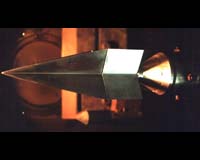
St Louis MO (SPX) Jan 04, 2007 Boeing has secured a key role in a $54 million hypersonics research program called HIFiRE (Hypersonic International Flight Research Experimentation) jointly established by the U.S. Air Force Research Laboratory (AFRL) and Australia's Defence Science and Technology Organisation (DSTO). Under a recently-signed agreement enabled by a Queensland Government award, Boeing will work with the DSTO and The University of Queensland on three critical flight tests and will contribute to the design of a free-flying WaveRider-type hypersonic vehicle that will be used in two of those flight tests. "We're very pleased to have this opportunity to continue our successful research in hypersonic flight," said Bob Krieger, Boeing chief technology officer and president of Phantom Works. "Boeing has been at the forefront of hypersonics research with successful programs like the X-43A Hyper-X vehicle, and this collaboration will provide new knowledge about hypersonic flight that could open new frontiers in aerospace." "Boeing has a rich legacy of many decades in hypersonics research, and we look forward to this new cooperative effort with our Australian partners," said George Muellner, president of Boeing Advanced Systems. Plans for the HIFiRE program call for 10 total flight tests over five years at Woomera in South Australia. The three flight tests that are the primary focus of the Boeing collaboration with Australian partners will be the fourth, seventh and eighth in the schedule. Sequentially, they will be of a WaveRider-type vehicle as an unpowered glider; a scramjet engine alone; and the WaveRider-type vehicle powered by the same scramjet engine. Boeing's collaboration in the HIFiRE project stems from a prior collaboration in scramjet development with the DSTO, the Government of Queensland and The University of Queensland that was announced in April 2006. Each of the parties is making cash and in-kind contributions to build advanced scramjet prototypes and undertake prolonged flight tests at speeds of more than Mach 8, or 5,450 miles per hour. The University of Queensland Centre for Hypersonics was the first in the world to successfully achieve verified supersonic combustion of a scramjet in flight, launching its Supersonic Combustion Ramjet (Scramjet) in 2002 under the HyShot Flight Program. The Boeing/ATK X-43A Hyper-X vehicle, powered by a scramjet engine, recorded the fastest speeds ever achieved in flight by an air-breathing vehicle (Mach 6.83 or about 4,600 miles per hour and Mach 9.68 or about 6,600 miles per hour) in two successful flight tests in 2004. The DSTO leads the Australian portion of the HIFiRE program, which involves researchers from The University of Queensland, the Australian National University, the University of New South Wales at the Australian Defence Force Academy, and the governments of Queensland and South Australia. The AFRL leads U.S. participation, with contributions from NASA, U.S. industry and U.S. universities. Boeing participation comes from Phantom Works in Engineering, Operations and Technology and from Advanced Systems in Integrated Defense Systems. Related Links Phantom Works Rocket Science News at Space-Travel.Com Rocket Science News at Space-Travel.Com
 First South Korean Space Rocket To Launch In 2008
 Seoul (AFP) Jan 02, 2007
South Korea plans to launch its first space rocket next year, becoming the world's ninth country to do so, officials said Tuesday. A space centre on the country's south coast is some 90 percent complete after construction began in late 2000 at a cost of 265 billion won (285 million dollars). |
|
|

| The content herein, unless otherwise known to be public domain, are Copyright Space.TV Corporation. AFP and UPI Wire Stories are copyright Agence France-Presse and United Press International. ESA Portal Reports are copyright European Space Agency. All NASA sourced material is public domain. Additional copyrights may apply in whole or part to other bona fide parties. Advertising does not imply endorsement, agreement or approval of any opinions, statements or information provided by Space.TV Corp on any Web page published or hosted by Space.TV Corp. Privacy Statement |