 |
 |
 |
 |
 |
 |
 |
 |
 |

 |
Boeing Completes Prototype Heat Shield For NASA Orion Spacecraft
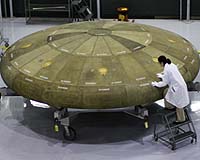
St. Louis MO (SPX) Nov 14, 2007 Boeing has completed a developmental heat shield for NASA's Orion Crew Exploration Vehicle (CEV) that is designed to protect future astronauts from extreme heat during re-entry into Earth's atmosphere following lunar and low-Earth orbit missions. NASA Ames Research Center last year awarded Boeing Advanced Systems a contract to deliver a Thermal Protection System (TPS) Manufacturing Demonstration Unit (MDU) for the Orion capsule as part of NASA's Constellation program to return humans to the moon and on to Mars. "Boeing took on the challenge of engineering, fabricating and assembling the largest ablative heat shield ever constructed," said Thomas Andrews, Boeing Thermal Protection System program manager. "Our Manufacturing Demonstration Unit met NASA's Advanced Development Program risk reduction objectives to move the Orion heat shield program toward full-scale development in preparation for CEV missions." Development of the five-meter wide TPS MDU began in late 2006 at Boeing in Huntington Beach, Calif. Last month, a NASA Ames technical and quality inspection team successfully completed an acceptance review of the unit. Boeing today shipped the TPS MDU to NASA's Kennedy Space Center in Florida where it will undergo additional inspection. "The successful completion of this new heat shield is a major achievement by our TPS team," said Alex Lopez, Boeing vice president of Advanced Network and Space Systems. "Boeing has greatly improved upon TPS design, analysis and production to meet the harsh environments of lunar return missions. We have the processes, tools and capabilities to successfully produce reliable heat shields for Orion missions. Once again, Boeing is proud to be supporting NASA's space exploration efforts." Boeing's baseline TPS is fabricated from Phenolic Impregnated Carbon Ablator (PICA) material. Fiber Materials Inc., of Biddeford, Maine, produces the material under a contract to Boeing. PICA is being considered for Orion's heat shield due to its proven performance on NASA's Stardust spacecraft heat shield. The Boeing TPS MDU consists of an integrated concept made up of multiple PICA components. Each piece is significantly larger than typical space shuttle tiles, greatly reducing parts count and complexity. Boeing installed the TPS MDU onto a NASA-provided surrogate carrier structure representing the size and shape of the flight heat shield structure, but fabricated from alternate materials pending development of the final flight structure. In addition to the TPS MDU, Boeing has provided NASA other Orion-related hardware including hundreds of arc jet test coupons (sample pieces of PICA and other materials for extreme heat testing), structural and environmental test assemblies, and Local Design Demonstration Units representing structural and thermal protection components of the system that joins Orion's Crew and Service Module elements. Boeing is continuing its work with NASA Ames to develop the flight heat shield design in support of Orion's TPS preliminary design review in early 2008. Related Links Space Tourism, Space Transport and Space Exploration News
 Spaceship Mockup
 Edwards CA (SPX) Nov 07, 2007
NASA's Orion spacecraft now in development is America's first new manned spacecraft since development of the space shuttle 30 years ago. It's the centerpiece of NASA's Constellation program, which aims to take the next generation of human explorers to the moon and beyond. Orion's launch abort system, a "rocket on top of the rocket," is designed to ensure the safety of its astronaut crew by pulling the crew module away from it's booster rocket in the event of a booster malfunction, either while on the launch pad or during ascent to orbit. |
|
|

| The content herein, unless otherwise known to be public domain, are Copyright Space.TV Corporation. AFP and UPI Wire Stories are copyright Agence France-Presse and United Press International. ESA Portal Reports are copyright European Space Agency. All NASA sourced material is public domain. Additional copyrights may apply in whole or part to other bona fide parties. Advertising does not imply endorsement, agreement or approval of any opinions, statements or information provided by Space.TV Corp on any Web page published or hosted by Space.TV Corp. Privacy Statement |