
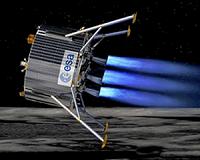
 There are many technological challenges to be met in planning to place an automated vehicle on the Moon. Essential to its soft and precise landing are advanced technologies such as an autonomous navigation system and a sophisticated propulsion system. |
The new contract, valued at euros 6.5 million with a significant contribution from Germany, will see the study run for 18 months to the end of 2011. The final result of the study will be a fully defined mission concept and a detailed design of the landing vehicle and Moon rover.
The study will consolidate the system design concept - together with an initial design for the landing module and the essential technologies for an automatic, soft and precise landing. Other aspects of the study include testing engine hardware components and navigation sensors using equipment capable of recreating a realistic lunar environment.
The Phase B1 study will confirm the Lunar Lander's overall cost and schedule as a basis for a decision on the financing of the full mission at ministerial level at the next ESA Council Meeting.
Following this decision and once the Phase B1 study is complete, ESA will then be able to move on to the next step of the programme by issuing a contract for the development, construction and testing of the Lunar Lander.
"The proven capabilities of the Automated Transfer Vehicle (ATV) as a technology demonstration are representative of Astrium's skills and experience in automated rendezvous and docking procedures. The concept of the new study is based on ATV technology and this unique expertise will enable us to develop the key technologies required for the Lunar Lander. It would not be possible to envisage landing an automated vehicle on the Moon without them.", said Dr. Michael Menking, Astrium's Senior Vice President, Orbital Systems and Space Exploration, when the contract was signed on 16 September in Berlin.
"It is a great pleasure to see progress being made in Europe in the field of space exploration relying on key technologies developed for human spaceflight.", affirmed Mrs. Di Pippo, ESA Director for Human Spaceflight.
"As we prepare ourselves to join the US, Russia and Japan in the decision to utilize the International Space Station (ISS) for ten more years and beyond, we are preparing the next steps and we are working to position Europe at the level of its competences and capabilities within the global exploration undertaking. With a strong and successful presence in LEO, the Moon is the next natural goal on our common path to further destinations. Europe is actively and successfully present in these global projects, like ISS and exploration, which contribute to affirm our role as a modern, dynamic and innovation-driven continent.", she added
There are many technological challenges to be met in planning to place an automated vehicle on the Moon. Essential to its soft and precise landing are advanced technologies such as an autonomous navigation system and a sophisticated propulsion system.
After landing, the Moon rover will leave the landing module and start to explore the surface. At the same time, a variety of stationary instruments will start to record experimental data. This research stage of the mission is expected to last between six and eight months.
 del.icio.us del.icio.us |
 Digg Digg |
 Reddit Reddit |
 YahooMyWeb YahooMyWeb |
 Google Google |
 Facebook Facebook |

 Next Step For ESA's First Moon Lander
| The content herein, unless otherwise known to be public domain, are Copyright 1995-2010 - SpaceDaily. AFP and UPI Wire Stories are copyright Agence France-Presse and United Press International. ESA Portal Reports are copyright European Space Agency. All NASA sourced material is public domain. Additional copyrights may apply in whole or part to other bona fide parties. Advertising does not imply endorsement,agreement or approval of any opinions, statements or information provided by SpaceDaily on any Web page published or hosted by SpaceDaily. Privacy Statement |


