
SPACE TRAVEL SPACE DAILY SPACE WAR TERRA DAILY MARS DAILY SPACE MART GPS DAILY ENERGY DAILY
  Space Travel News  
Get Our Free Newsletters Via Email
  
Search All Our Sites at SpaceBank
AeroAstro-built STPSat-1 Spacecraft Positions For Shuttle Plume

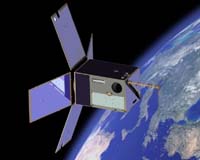
File image of the STPSat-1 spacecraft in orbit.
by Staff Writers
Ashburn (SPX) Aug 09, 2007
AeroAstro today announced that STPSat-1 payload, SHIMMER, has successfully gathered data from the June 8th launch of Space Shuttle Atlantis. Twenty-four hours before the launch, operators at the Space Development and Test Wing, Kirtland AFB, NM rolled the spacecraft 0.66 degrees by ground command to point the payload to a higher altitude to observe the vapor plume put off by the STS-117 mission.

The Space Shuttle uses liquid oxygen and hydrogen to fuel its boosters. This results in over 400 metric tons of water being released into the atmosphere.

"By looking at the exhaust plume at 115 km altitude, we can analyze whether or not this matter is transferred toward the poles," said Chris Englert, Principal Investigator for SHIMMER.

"Further, this should give the SHIMMER experimenters insight into how water transport works in this section of the upper atmosphere, as there is little water naturally occurring in this region."

SHIMMER (Spatial Heterodyne Imager for Mesospheric Radicals), the primary experiment on STPSat-1, is a high-resolution ultraviolet spectrometer based on the new optical technique known as Spatial Heterodyne Spectroscopy (SHS).

The STPSat-1 Spacecraft
STPSat-1 continues the Space Development and Test Wing's mission to provide access to space for DoD-sponsored experiments. The spacecraft's elegant design incorporated both proven technical design from previous missions and advanced technologies. The satellite construction was tailored for the highly constrained ESPA environment and included advances in electronics packaging, space materials and manufacturing techniques.

Technology Abstract
SHIMMER, the Spatial Heterodyne Imager for Mesospheric Radicals is the primary payload of STPSat-1, a small satellite launched in March 2007 with a minimum lifetime of one year.

SHIMMER will use Spatial Heterodyne Spectroscopy (SHS) to measure the limb brightness at 32 tangent altitudes with high spectral resolution (0.012nm) in a narrow bandpass around 308 nm. The solar resonance fluorescence of hydroxyl (OH) will be reduced from the limb profiles and inverted to provide OH concentration profiles for low to mid latitudes (up to 57 degrees).

Since OH is a good proxy for water vapor in the upper mesosphere and lower thermosphere, water vapor concentrations will also be available from the data.

We will review the basics of SHS, its differences and similarities to other spectroscopic techniques, and its suitability for the measurement of middle atmospheric OH in the UV. The specific design of SHIMMER on STPSat-1, which includes a monolithic SHS interferometer, will be presented.

We will give a brief overview of the primary science goals of the SHIMMER on STPSat-1 mission and discuss the projected scientific return in context of its latitudinal coverage, atmospheric lighting conditions, and planned operations.

In conclusion we will discuss the ability to make Polar Mesospheric Cloud observations with this instrument and how it can complement the NASA AIM (Aeronomy of Ice in the Mesosphere) mission, scheduled for launch in late 2006. SHIMMER is a joint effort between the Naval Research Laboratory and the DoD Space Test Program.

Community
Email This Article
Comment On This Article

Related Links
PDF paper on STPSat-1 at Aeroastro
AeroAstro
Shuttle at NASA
Watch NASA TV via Space.TV
Space Shuttle News at Space-Travel.Com


Completing The Mission After 21 Years
Greenbelt MD (GSFC) Aug 08, 2007
Dear Friends: It is time for another one of those periodic rambling e-mails that yours truly is famous for sending out on occasion. I know I've missed sending out year-end summary of activities in holiday cards and promise to give the complete Eduardo recap at some point later this year but for now, I just would like to talk two numbers: 7,861 and 1.

   Add to Delicious


Memory Foam Mattress Review

Newsletters :: SpaceDaily Express :: SpaceWar Express :: TerraDaily Express :: Energy Daily
XML Feeds :: Space News :: Earth News :: War News :: Solar Energy News
  • Indigenous Cryogenic Stage Tested For Eight Minutes
  • UC Experts Detail New Standard For Cleaner Transportation Fuels
  • Ecliptic Celebrates A Decade Of Successful RocketCam Launches
  • Launch Gantry At Cape A Bridge To The Future

  • Russian Proton-M Rocket To Launch Japanese Telecoms Satellite
  • ILS to Launch Inmarsat Satellite On Proton Vehicle Next Spring
  • European Automated Space Truck Arrive At South American Spaceport
  • A Double Transfer At The Spaceport For The Next Two Ariane 5 Launchers

  • AeroAstro-built STPSat-1 Spacecraft Positions For Shuttle Plume
  • Completing The Mission After 21 Years
  • NASA Design Challenge Registration Opens
  • NASA Launches Space Shuttle Endeavour For Station Teach-In

  • Progress Cargo Ship With Computer Equipment Docks With ISS
  • Progress 26 To Dock Sunday At Station
  • Russian Space Cargo Ship Progress Undocks From ISS
  • Progress To Launch To Space Station

  • Historic Phoenix Mars Mission Flies Actel RTAX-S Devices
  • Spaceport America Design Team Selected
  • Making the Transition From Shuttle To Constellation
  • Udall Says House NASA Budget A Step In The Right Direction

  • China Trains Rescue Teams For Third Manned Space Program
  • China Prepares To Select New Taikonauts
  • Chinese Astronauts Begin Training For Spacewalk
  • Dongfanghong 4 Ready For More International Satellite Orders

  • Successful Jules Verne Rendezvous Simulation At ATV Control Centre
  • Robotic Einstein Wows Spanish Technology Fair
  • Robotic Ankle For Amputees Is Developed
  • iRobot Receives New Military Orders 14 PackBot Robots

  • Brighter Skies Lifts Rover Spirit As MER-A Gets Active
  • Dallas Professor Helps Mission To Red Planet
  • NASA Spacecraft Heads For Polar Region Of Mars
  • Extreme Analytical Chemistry Will Help Unravel Mars Mysteries

  • The content herein, unless otherwise known to be public domain, are Copyright 1995-2006 - SpaceDaily.AFP and UPI Wire Stories are copyright Agence France-Presse and United Press International. ESA PortalReports are copyright European Space Agency. All NASA sourced material is public domain. Additionalcopyrights may apply in whole or part to other bona fide parties. Advertising does not imply endorsement,agreement or approval of any opinions, statements or information provided by SpaceDaily on any Web page published or hosted by SpaceDaily. Privacy Statement