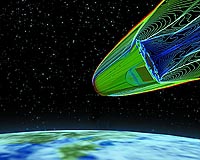
The ceramic matrix composite nose cap for Earth atmosphere re-entry vehicles developed at the German Aerospace Center in Stuttgart is now fit for space. It has passed the required final load tests on the ground successfully, so it is now ready for flight.
As a central component of EXPERT (European eXPErimental Reentry Testbed), a European experimental re-entry vehicle, the nose cap's integrated measuring instruments will collect important data during the Earth atmosphere re-entry phase of its 2010 flight.
Four years of development
After four years of development and the subsequent construction phase of the fibre-reinforced ceramic cap, in which the Departments of Space System Integration and Ceramic Composites Structures at the Stuttgart-based DLR Institute of Structures and Design were prominently involved, the nose has now been subjected to vibration tests on a so-called shaker at the European Space Agency ESA in Noordwijk, The Netherlands. Extreme vibrations were used to simulate the loads at launch.
The nose cap then passed shock tests at T�V Italy's test facility in Turin. These tests confirmed that the cap is also able to withstand the impulsive loads brought about by stage separations when the rocket is launched.
Thermal testing of selected components of the nose cap had already been completed successfully in the plasma wind tunnels at DLR in Cologne earlier.
Extreme loads during re-entry
During re-entry into the Earth's atmosphere, the aerodynamic loads on a spacecraft are carried mainly by the ceramic nose. This is also where the highest heat loads occur. The nose heats up to a temperature of up to 2 100 degrees Celsius.
In order to determine these environment data, sensors have been integrated into the nose cap developed by DLR. These measure surface temperature, heat flux and aerodynamic pressure. In addition to this, a sapphire glass window able to withstand temperatures of up to 1 000 degrees is set into the nose cap.
Through this window, the chemical processes taking place in the shock region during re-entry can be registered using a spectrometer developed by the Institute of Space Systems at the Universit�t Stuttgart.
The data collected during re-entry will provide important information for the development and aerothermodynamic design of future spacecraft. The EXPERT capsule will be able to collect more accurate data than its predecessors EXPRESS and MIRKA.
A boost for the EXPERT project
"All in all, the successful tests are an enormous boost for the project - now we can fully focus on producing the nose cap," said project manager Thomas Reimer of the DLR Institute of Structures and Design. By spring 2009, his team will have made an identical copy of the cap used in the tests.
This copy will then be handed over to the Thales Alenia Space aerospace company in Italy, which is expected to complete the EXPERT capsule by mid-2009.
"The mission is planned for 2010," Reimer adds. EXPERT will then be launched from a submarine in the Pacific Ocean using a Russian Volna rocket. It will complete a sub-orbital flight before landing on the Kamchatka Peninsula in Russia 15 minutes later.