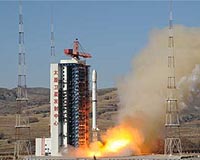
China on Monday launched a remote-sensing satellite, "Yaogan V," from the Taiyuan Satellite Launch Center in north Shanxi Province. The satellite was launched with a Long March-4B carrier rocket at 11:22 a.m., the center said.
The satellite will be used for data collection and transmission involving land resources surveys, environmental surveillance and protection, urban planning, crop yield estimates, disaster prevention and reduction, and space science experiments.
Xu Hongliang, director of the center, said the flight had been carried out under extreme low temperature, with the lowest reaching minus 29 degrees celsius in the past few days.
However, its success showed that the designing of the launcher, which was put into use in September, was up to standard and capable of working in low temperature.
The center's staff had also drawn on successful domestic and foreign experience of low-temperature launching and made much effort for its success, he said.
The satellite's predecessor, "Yaogan IV," was launched from the Jiuquan Satellite Launch Center in northwestern Gansu Province earlier this month. "Yaogan III" was launched from Taiyuan on Nov.12, 2007.
The "Yaogan I" and "Yaogan II" satellites were launched in April 2006 and May 2007, respectively.
The satellite was developed by the China Aerospace Science and Technology Corp., while the rocket was designed by the Shanghai Academy of Space flight Technology, which is under the corporation.
The flight was the 114th of the Long March series of carrier rockets.
Source: Xinhua News Agency