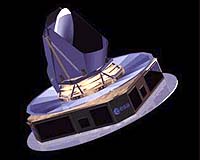
The launch vehicle for Arianespace's second Ariane 5 flight of 2009 has begun its assembly at the Spaceport in French Guiana, marking the startup of preparations for a dual-satellite mission that will yield new insights into the formation of stars and the universe's creation.
During activity in the Spaceport's Launcher Integration Building, the Ariane 5's core cryogenic stage was situated over its massive mobile launch table, followed by the positioning of the vehicle's two solid rocket boosters.
Liftoff of this Ariane 5 is planned for April with a pair of European Space Agency space science payloads: the Herschel space telescope, and the Planck spacecraft. Herschel will study the formation of stars and galaxies, while Planck is to gather data on remaining radiation from the Big Bang cosmic explosion.
Herschel will be the largest space telescope of its kind ever launched. Its ability to detect space radiation at far infrared and sub-millimeter wavelengths will help scientists to determine how the first galaxies were created, and how they evolved into their present-day form.
The Planck spacecraft will analyze radiation remnants that filled the universe immediately after the Big Bang, which are observed today as the Cosmic Microwave Background. Data from Planck will provide answers to the universe's creation, and how it could evolve in the future.
Arianespace is maintaining the Ariane 5 mission pace to meet its customers' needs, with plans for a total of six to eight launches this year. The first liftoff of 2009 is set for this Thursday, February 12, with the vehicle now ready for its rollout to the Spaceport's ELA-3 launch zone.