
. Space Travel News .


.
STATION NEWS
SpaceX Launches Falcon 9 Dragon on Historic Mission
by Steven Siceloff for KSC News
Cape Canaveral FL (SPX) May 24, 2012

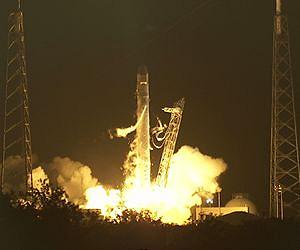
The SpaceX Falcon 9 rocket lifts off from Space Launch Complex-40 at Cape Canaveral Air Force Station, Fla., to begin a demonstration flight. Photo credit: NASA TV.

A SpaceX Falcon 9 rocket thundered into space and delivered a Dragon cargo capsule into orbit on May 22, 2012. The launch began an ambitious mission to show that the company is ready to deliver cargo to the International Space Station.

"We're now back on the brink of a new future, a future that embraces the innovation the private sector brings to the table," said NASA Administrator Charles Bolden. "The significance of this day cannot be overstated. While there is a lot of work ahead to successfully complete this mission, we are off to a good start."

Working with an instantaneous launch window, SpaceX, short for Space Exploration Technologies of Hawthorne, Calif., proceeded through a flawless countdown. Liftoff from Space Launch Complex-40 at Cape Canaveral Air Force Station in Florida came at 3:44 a.m. EDT, just as the station was crossing 249 miles above the North Atlantic.

"Every bit of adrenaline in my body released at that moment," said Elon Musk about the moment the rocket lifted off the pad. Musk is the founder, CEO and chief designer of SpaceX. "People were really giving it their all. For us, it was like winning the Super Bowl."

The launch came three days after the rocket aborted a previous launch attempt. William Gerstenmaier, NASA's associate administrator for Human Exploration and Operations Mission Directorate, lauded the company for getting the craft ready for the successful launch.

"They stayed focused and kept moving forward," Gerstenmaier said. "Things are moving in the right direction."

Dragon is carrying about 1,200 pounds of supplies for the crew of the station and experiments designed by students. The spacecraft can hold 7,300 pounds of material for delivery to the station, but since this is a test flight, the manifest was limited to important but not critical materials. Food and clothing make up the bulk of the supplies.

The launch put the Dragon on a course to rendezvous with the space station in three days. A detailed series of navigation and other systems tests will be performed in space before the capsule is allowed to move close enough to the station for astronauts to grab it with the robot arm and connect it to the Earth-facing port of the Harmony module.

The tests include a careful approach to the station that calls for the spacecraft to pause several times. The space station crew also will show that they can communicate directly with the uncrewed Dragon capsule. If all the testing goes well, they will go ahead with the rendezvous and berthing.

"There's still a thousand things that have to go right, but we are looking forward to this exciting mission," said Alan Lindemoyer, manager of NASA's Commercial Crew and Cargo Program.

The Dragon will remain connected to the station for about three weeks, allowing astronauts to empty it before loading used scientific equipment inside for the return to Earth.

Reversing the process of connecting the spacecraft to the station, astronauts will use the robotic arm to remove the Dragon capsule. The Dragon will then de-orbit and return to Earth under parachutes, splashing down in the Pacific Ocean off the California coast.

Related Links
SpaceX
Station at NASA
Station at NASA
Station and More at Roscosmos
S.P. Korolev RSC Energia
Watch NASA TV via Space.TV
Space Station News at Space-Travel.Com


.
.
Get Our Free Newsletters Via Email
...
Buy Advertising Editorial Enquiries


And it's 3... 2... 1... blastoff! Discover the thrill of a real-life rocket launch.


.

. Comment on this article via your Facebook, Yahoo, AOL, Hotmail login.

Share this article via these popular social media networks
del.icio.usdel.icio.us DiggDigg RedditReddit GoogleGoogle


STATION NEWS
SpaceX Dragon Transports Student Experiments to Space Station
Washington DC (SPX) May 24, 2012
The SpaceX Dragon capsule, which on Tuesday became the first commercially developed and built spacecraft to launch to the International Space Station, is carrying among its cargo a suite of 15 science experiments designed by students. Known collectively as Aquarius, the experiments will assess the effects of microgravity on physical, chemical and biological systems. The students have been ... read more


STATION NEWS
SpaceX Launches NASA Demonstration Mission to ISS

SpaceX capsule has 'new car' smell, astronauts say

SpaceX's Dragon makes historic space station dock

SpaceX makes final approach to space station

STATION NEWS
How To Keep A Mars Tumbleweed Rover Moving On Rocky Terrain

NASA Funded Research Shows Existence of Reduced Carbon on Mars

Waking Up with the Sun's Rays

Did Ancient Mars Have a Runaway Greenhouse?

STATION NEWS
NASA Offers Guidelines To Protect Historic Sites On The Moon

Neil Armstrong gives rare interview - to accountant

Perigee "Super Moon" On May 5-6

India's second moon mission Chandrayaan-2 to wait

STATION NEWS
Beyond Pluto And Exploring the Kuiper Belt

Uranus auroras glimpsed from Earth

Herschel images extrasolar analogue of the Kuiper Belt

STATION NEWS
Newfound exoplanet may turn to dust

Cosmic dust rings no guarantee of planets

In search of new 'Earths' beyond our Solar System

Free-floating planets in the Milky Way outnumber stars by factors of thousands

STATION NEWS
Pictures show N. Korea rocket launch upgrade

Internet entrepreneur hits paydirt in space, autos

NASA Team to Test New Vehicle-Descent Technologies

Robotic Refueling Mission Results To Be Presented At NASA Satellite-Servicing Workshop

STATION NEWS
Tiangong 1 Ready To Meet Shenzhou 9

Sri Lanka plans to launch its first satellite in 2015

When Will Shenzhou 9 Be Launched

China's space women wait for blast-off

STATION NEWS
Asteroid Nudged by Sunlight: Most Precise Measurement of Yarkovsky Effect

NASA Scientist Figures Way to Weigh Space Rock

NASA Survey Counts Potentially Hazardous Asteroids

NASA Dawn Spacecraft Reveals Secrets of Large Asteroid


Memory Foam Mattress Review

Newsletters :: SpaceDaily Express :: SpaceWar Express :: TerraDaily Express :: Energy Daily
XML Feeds :: Space News :: Earth News :: War News :: Solar Energy News

.

The content herein, unless otherwise known to be public domain, are Copyright 1995-2012 - Space Media Network. AFP, UPI and IANS news wire stories are copyright Agence France-Presse, United Press International and Indo-Asia News Service. ESA Portal Reports are copyright European Space Agency. All NASA sourced material is public domain. Additional copyrights may apply in whole or part to other bona fide parties. Advertising does not imply endorsement,agreement or approval of any opinions, statements or information provided by Space Media Network on any Web page published or hosted by Space Media Network. Privacy Statement