
SPACE TRAVEL SPACE DAILY SPACE WAR TERRA DAILY MARS DAILY SPACE MART GPS DAILY ENERGY DAILY
  Space Travel News  
Get Our Free Newsletters Via Email
  
Search All Our Sites at SpaceBank
Rosetta Closing In On Earth Again For Second Gravity Boost

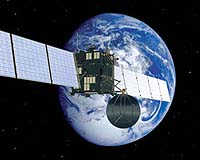
The first Earth swing-by took place on 4 March 2005.
by Staff Writers
Paris, France (ESA) Nov 09, 2007
ESA's comet chaser, Rosetta, is on its way to its second close encounter with Earth on 13 November. The spacecraft's operators are leaving no stones unturned to make sure Earth's gravity gives it the exact boost it needs en route to its destination.

This month's Earth swing-by is Rosetta's third major step on its 10-year journey to 67/P Churyumov-Gerasimenko. The trajectory correction manoeuvre successfully performed last month prepared ESA's Comet Chaser for the upcoming encounter. The spacecraft is now right on track to gain the right amount of energy from Earth's gravity and save fuel later on.

Closest approach will take place on 13 November 2007 at 21:57 CET, at which time Rosetta will speed past at 45 000 km/h (about 12.5 km/s) relative to Earth. At this time, Rosetta will be 5301km above the Pacific Ocean, south-west of Chile, at 63 degrees 46 minutes South and 74 degrees 35 minutes West.

Why swing by Earth?
Swing-bys make use of the gravitational attraction of planets to modify a spacecraft's trajectory and to gain the orbital energy needed to reach the final target.

The first Earth swing-by took place on 4 March 2005. On 25 February 2007 Rosetta made its closest approach to Mars, to use its gravity. The swing-by this month will be followed by the third and last swing-by, using Earth's gravity, on 13 November 2009.

While the gravity-assist manoeuvre at Mars was needed to slow the spacecraft down and head back towards the inner solar system, the second Earth swing by will help Rosetta gain enough energy to reach the outer Solar System through the asteroid belt and observe asteroid Steins, one of its scientific targets. Rosetta will then head back to Earth for the last planned swing-by in November 2009.

The increased energy from this Earth swing-by will help Rosetta cross the asteroid belt for a second time, observe Lutetia (its second target asteroid) and finally rendezvous with comet 67/P Churyumov-Gerasimenko. The rendezvous will take place about 4 astronomical units or 600 million km from the Sun, in 2014.

Intense activity coming up
During this Earth swing-by, the highest priority will be given to spacecraft operations, as the manoeuvre is critical for the success of the overall mission. In addition, during the incoming and outgoing tracks of the swing-by, Rosetta will be under unfavourable solar illumination and thus temperature conditions. This is why only very limited slots will be available for the instruments to be used safely.

Despite this, a few experiments both on the orbiter and the Philae lander will be activated for calibration, scientific measurements and imaging. The observations are scheduled during and around the time of closest approach, from 7 Nov, 01:00 CET, to 20 Nov, 15:00 CET.

Rosetta will first point to Earth to make observations of the atmosphere and the magnetosphere, including a search for shooting stars from space. It will image urban regions in Asia, Africa and Europe and then point to the Moon and obtain spectra of the illuminated Moon. Flying away after closest approach, Rosetta will image the Earth-Moon system from a distance.

Rosetta will be controlled from ESA's Spacecraft Operations Centre (ESOC) in Darmstadt, Germany

For more detail about Rosetta's spacecraft and scientific operations, please read the Rosetta second Earth swing-by Q and A.

For the swing-by, the ESA Web portal is hosting a Rosetta swing-by blog providing frequent updates, news and information direct from the Rosetta Dedicated Control Room at ESOC.

Community
Email This Article
Comment On This Article

Related Links
Rosetta
ESA Spacecraft Operations
Space Tourism, Space Transport and Space Exploration News


Bonn Astronomers Simulate Life And Death In The Universe
Bonn, Germany (SPX) Nov 02, 2007
Stars always evolve in the universe in large groups, known as clusters. Astronomers distinguish these formations by their age and size. The question of how star clusters are created from interstellar gas clouds and why they then develop in different ways has now been answered by researchers at the Argelander Institute for Astronomy at the University of Bonn with the aid of computer simulations. The scientists have solved - at least at a theoretical level - one of the oldest astronomical puzzles, namely the question of whether star clusters differ in their internal structure.


Memory Foam Mattress Review

Newsletters :: SpaceDaily Express :: SpaceWar Express :: TerraDaily Express :: Energy Daily
XML Feeds :: Space News :: Earth News :: War News :: Solar Energy News
  • ATK Selects Avionics Contractor For Ares I First Stage
  • Kelly Space Launches Indoor Rocket Engine Test Service
  • SpaceDev Completes Milestone Under NASA Space Act Agreement
  • Opportunity Studies Rock Composition And Changes In Atmosphere

  • Arianespace's 5th Ariane 5 Mission Is Cleared For November 9 Liftoff
  • Skynet 5B Satellite Ready For Launch On 9th November
  • ESA To Provide Essential Launch Control Services To EUMETSAT
  • China May Use Long March 3 For Lunar Landing

  • Shuttle returns safely to Earth after complex mission
  • NASA's Space Shuttle Atlantis To Move To Launch Pad Saturday
  • Discovery's Return Marks Completion Of Esperia Mission
  • Discovery Set For Landing After Successful Solar Panel Install And Repair Operation

  • ISS astronauts prepare Harmony module for permanent docking
  • Friday Spacewalk To Prepare For PMA And Harmony Moves
  • Discovery Mission Readies Station For International Partner Labs
  • Korean Astronaut To Ride On Soyuz April Flight With ISS Crew 17

  • Rosetta Closing In On Earth Again For Second Gravity Boost
  • Repair Shops For Broken DNA
  • Spaceship Mockup
  • Malaysia may buy Russian space rocket

  • China to accept private funding for lunar missions
  • China Denies Timetable For Space Station
  • China targets space station in 2020: report
  • China Starts Developing New Heavy-Duty Carrier Rockets

  • Proton Rocket To Launch Glonass Satellites Friday
  • Can A Robot Find A Rock. Interview With David Wettergreen: Part IV
  • QinetiQ Establishes Service And Support Centre For Talon Robots In Australia
  • UCSD Researchers Give Computers Common Sense

  • Opportunity's Second Martian Birthday At Cape Verde
  • Spirit To Head North For The Winter
  • Opportunity Studies Bathtub Ring In Victoria
  • Mars Express Probes The Red Planet's Most Unusual Deposits

  • The content herein, unless otherwise known to be public domain, are Copyright 1995-2006 - SpaceDaily.AFP and UPI Wire Stories are copyright Agence France-Presse and United Press International. ESA PortalReports are copyright European Space Agency. All NASA sourced material is public domain. Additionalcopyrights may apply in whole or part to other bona fide parties. Advertising does not imply endorsement,agreement or approval of any opinions, statements or information provided by SpaceDaily on any Web page published or hosted by SpaceDaily. Privacy Statement