SPACE TRAVEL SPACE DAILY SPACE WAR TERRA DAILY MARS DAILY SPACE MART GPS DAILY ENERGY DAILY
  Space Travel News  
Get Our Free Newsletters Via Email
  
Search All Our Sites at SpaceBank
Rare Herbal Plants Aboard Shenzhou-7 Spacecraft Studied

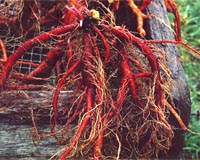
Salvia miltiorrhiza
by Staff Writers
Beijing (XNA) Oct 06, 2008
Several rare herbal plants aboard the recent Shenzhou-7 space mission have now been transferred to a Chinese nanobiotechnology lab for study.

The plants, including rauwolfia and salvia miltiorrhiza (also known as red sage), were used to produce nanomedicines to treat cancerous tumors, Professor Zhang Yangde with China's Laboratory of Nanobiotechnology at the Central South University told the Changsha Daily newspaper in Hunnan Province on Thursday.

Anti-tumor nanomaterials can be obtained from extracts of the herbal plants, Zhang said, adding researchers hoped the microgravity environment in outer space could have spurred gene mutation of the plants and enabled them to grow and reproduce faster.

Rauwolfia is a genus of evergreen trees and shrubs of the Apocynaceae family. Rich in alkaloid, the plant is widely used to produce anti-hypertensive drugs.

The natural reserves of this plant are declining as a result of over-harvesting. The international Union for Conservation of Nature and Natural Resources has listed the plant as endangered.

Salvia miltiorrhiza is a shade-providing perennial flowering plant,highly valued for its roots in traditional Chinese medicine.

Other samples aboard the spacecraft included the seeds of 25 endangered plants and live samples of aquatic animals and plants.

The Shenzhou-7 space module carrying three taikonauts landed safely by parachute on Sept. 28 in China's northern grasslands after a 68-hour flight. The mission included the first ever spacewalk by a Chinese astronaut.

Community
Email This Article
Comment On This Article

Share This Article With Planet Earth
del.icio.usdel.icio.us DiggDigg RedditReddit
YahooMyWebYahooMyWeb GoogleGoogle FacebookFacebook


Related Links
Space Tourism, Space Transport and Space Exploration News


Magnetic Hunger Could Drive Space Travelers Insane
Moscow (RIA Novosti) Oct 02, 2008
The absence of Earth's magnetic field could lead to astronauts developing mental disorders during interplanetary flights, particularly expeditions to Mars, Russian scientists said.

   Add to Delicious


Memory Foam Mattress Review

Newsletters :: SpaceDaily Express :: SpaceWar Express :: TerraDaily Express :: Energy Daily
XML Feeds :: Space News :: Earth News :: War News :: Solar Energy News
  • NASA And Air Force Work To Establish Hypersonic Science Centers
  • Iran To Conduct First Satellite Launch Soon
  • Outside View: Reusable rocket breakthrough
  • Grant For Eco-Friendly Rocket Engine

  • GOCE Team Gearing Up For New Launch Date
  • Chandrayaan-I Moved To Sriharikota For Launch
  • Russia Launches Thai Satellite On Converted Missile
  • Sea Launch Successfully Delivers Galaxy 19 To Orbit

  • Trouble on Hubble telescope delays space shuttle launch: NASA
  • Astronauts Prepare For Countdown Rehearsal
  • Shuttle Astronauts Begin Prelaunch Training Milestone
  • Endeavour's move to launch pad set

  • ISS Orbit Adjusted By Russian Progress Ship
  • Boeing Receives ISS Contract Extension
  • Europe's "space truck" heads for Pacific breakup
  • Russia's Space Agency Confirms 18th ISS Expedition

  • Rare Herbal Plants Aboard Shenzhou-7 Spacecraft Studied
  • International Space Station changes orbit awaiting tourist: report
  • Scientists working on space elevator
  • Magnetic Hunger Could Drive Space Travelers Insane

  • China Sets Sights On First Space Station
  • Analysis: China space launch raises fears
  • Emergency Rescue Vessels For Shenzhou-7 Spaceship Return
  • China hails spacewalk 'heroes' and sets eyes on moon

  • iRobot Awarded US Army Contract For Robotic Systems
  • Robots Learn To Follow
  • Robot-assisted surgery repairs fistulas
  • Robots may enhance disabled people's lives

  • An Opportunity For A Tour Will Be An Endeavour
  • Nicaraguan Volcano Provides Insight Into Early Mars
  • Mars Lander Sees Falling Snow, Soil Data Suggest Liquid Past
  • Mars Rover To Head Toward Bigger Crater

  • The content herein, unless otherwise known to be public domain, are Copyright 1995-2007 - SpaceDaily.AFP and UPI Wire Stories are copyright Agence France-Presse and United Press International. ESA Portal Reports are copyright European Space Agency. All NASA sourced material is public domain. Additional copyrights may apply in whole or part to other bona fide parties. Advertising does not imply endorsement,agreement or approval of any opinions, statements or information provided by SpaceDaily on any Web page published or hosted by SpaceDaily. Privacy Statement